Consciousness-Bliss Songbook
Eso Eso Param Prabhu

Eso eso părăm prăbhu āmār bhăgăbān
Āmār hiyār bedăn jātăn kăro ăbăsān
_Notes Songs "Eso Eso Param Prabhu" and "Come, Come, My Lord Supreme God" were composed as a related pair, intended to be sung together, with the English immediately following the Bengali. As Sri Chinmoy was teaching the songs, he requested the singers to “Sing as soulfully as possible. Very sweet. Soulfully, soulfully; no power." And he added, "So, please take [them] as… prayerful songs — prayerful, full of prayers inside.”<html></div></html> <html>
</html>
Come, Come, My Lord Supreme God

Come, come, my Lord Supreme God.
Put an end to my heart’s burning sufferings.
_Notes Songs "Eso Eso Param Prabhu" and "Come, Come, My Lord Supreme God" were composed as a related pair, intended to be sung together, with the English immediately following the Bengali. As Sri Chinmoy was teaching the songs, he requested the singers to “Sing as soulfully as possible. Very sweet. Soulfully, soulfully; no power." And he added, "So, please take [them] as… prayerful songs — prayerful, full of prayers inside.”<html></div></html> <html>
</html>
Aj Phuteche Hiya Kamal

Āj phuteche hiyā kămăl
Tāito āmār jibăn ămăl
_Notes Songs "Aj Phuteche Hiya Kamal" and "My Heart-Lotus Has Blossomed Today" were composed as a related pair, intended to be sung together, with the English immediately following the Bengali.<html></div></html> <html>
</html>
My Heart-Lotus Has Blossomed Today

My heart-lotus has blossomed today.
Therefore, my life is so, so pure.
_Notes Songs "Aj Phuteche Hiya Kamal" and "My Heart-Lotus Has Blossomed Today" were composed as a related pair, intended to be sung together, with the English immediately following the Bengali.<html></div></html> <html>
</html>
Amar Hiyar Kebal Swapan

Āmār hiyār kebăl swăpăn
Sāt ār chidānăndă bhăvăn
_Notes Songs "Amar Hiyar Kebal Swapan" and "My Heart’s Only Dream" were composed as a related pair, intended to be sung together, with the English immediately following the Bengali.<html></div></html> <html>
</html>
My Heart’s Only Dream

My heart’s only dream —
Existence-Consciousness-Bliss-Abode.
_Notes Songs "Amar Hiyar Kebal Swapan" and "My Heart’s Only Dream" were composed as a related pair, intended to be sung together, with the English immediately following the Bengali.<html></div></html> <html>
</html>
Nutan Pathe Chalbo Ami

Nutăn gāne gāibo giti māyer chărăn dhărbo
Nutăn păthe chălbo āmi nutăn păthe chălbo
_Notes Songs "Nutan Pathe Chalbo Ami" and "I Shall Walk Along a New Road" were composed as a related pair, intended to be sung together, with the English immediately following the Bengali.<html></div></html> <html>
</html>
I Shall Walk Along a New Road

I shall walk along a new road.
New songs I shall sing,
Clasping Mother’s Feet.
_Notes Songs "Nutan Pathe Chalbo Ami" and "I Shall Walk Along a New Road" were composed as a related pair, intended to be sung together, with the English immediately following the Bengali.<html></div></html> <html>
</html>
Dibo Ar Nibo

Dibo ār nibo nibo ār dibo ei dhărănite
Sujog peyechi părăm pitāre pujite sebite
_Notes Songs "Dibo Ar Nibo" and "I Shall Give and Take" were composed as a related pair, intended to be sung together, with the English immediately following the Bengali.<html></div></html> <html>
</html>
I Shall Give and Take

I shall give and take,
I shall take and give in the world.
What an opportunity to worship and serve
Our Father Supreme Lord!
_Notes Songs "Dibo Ar Nibo" and "I Shall Give and Take" were composed as a related pair, intended to be sung together, with the English immediately following the Bengali.<html></div></html> <html>
</html>
Savyasachi Tomar Sebai Benche Achi

Săvyăsāchi Săvyăsāchi tomār sebāi beñche āchi
Gurur bijoy ăhănishi săbāi shune dăshădishi
_Notes Songs “Savyasachi Tomar Sebai Benche Achi” and “Savyasachi, Your Service Keeps Me Alive” were composed as a related pair, intended to be sung together, with the English immediately following the Bengali. Sri Chinmoy composed the songs to express his gratitude to his student, Savyasachi Brown. Savyasachi offered his service in many ways, including, for decades and to the present day, as one of the main organizers of the annual Christmas Trips attended by Sri Chinmoy's students from all over the world.<html></div></html> <html>
</html>
Savyasachi, Your Service Keeps Me Alive

Savyasachi, Savyasachi, your service keeps me alive.
Sleeplessly you sing your Guru’s victory-song.
The world and the world-citizens hear you sing.
_Notes Songs “Savyasachi Tomar Sebai Benche Achi” and “Savyasachi, Your Service Keeps Me Alive” were composed as a related pair, intended to be sung together, with the English immediately following the Bengali. Sri Chinmoy composed the songs to express his gratitude to his student, Savyasachi Brown. Savyasachi offered his service in many ways, including, for decades and to the present day, as one of the main organizers of the annual Christmas Trips attended by Sri Chinmoy's students from all over the world.<html></div></html> <html>
</html>
Ashrita, Challenger and Winner

Ashrita, challenger and winner
Of the long century!
He has founded his name
In great China’s large heart-history.
_Notes Note: Sri Chinmoy wrote this song on December 17, 2004 to mark a Guinness World Record that was broken that day by his disciple, Ashrita Furman, during the Christmas Trip in Xiamen, China, by running 8 kilometers (nearly 5 miles) on stilts in just under 40 minutes. In the song, Sri Chinmoy refers to Ashrita as the “winner of the long century” — reflecting the fact that the previous record had stood for more than a 100 years. Ashrita credits his athletic ability to meditation techniques taught to him by Sri Chinmoy. Twenty years later, as of this publication, Ashrita’s record still stands, according to the Guinness World Records website.<html></div></html> <html>
</html>
Dibase Nishite Benche Achi Ami

Dibăse nishite beñche āchi āmi tomār khămār băle
Rākhibo āmāre prăti păle păle tăbă sudhā pădă tăle
_Notes Songs "Dibase Nishite Benche Achi Ami” and "Your Forgiveness-Power Keeps Me Alive” were composed as a related pair, intended to be sung together, with the English immediately following the Bengali.<html></div></html> <html>
</html>
Your Forgiveness-Power Keeps Me Alive

Your Forgiveness-Power keeps me alive
Day and night.
I shall place myself at Your Nectar-Feet
Every moment.
_Notes Songs "Dibase Nishite Benche Achi Ami” and "Your Forgiveness-Power Keeps Me Alive” were composed as a related pair, intended to be sung together, with the English immediately following the Bengali.<html></div></html> <html>
</html>
Khamar Jogya Nahi Ami Jishu

Khămār jogyă năhi āmi Jishu tăbu more khămā kăro
Dhărār timire nāmo dhire dhire āmāre jăriye dhăro
_Notes Songs "Khamar Jogya Nahi Ami Jishu" and "O Saviour Christ, Your Forgiveness I Deserve Not" were composed as a related pair, intended to be sung together, with the English immediately following the Bengali.<html></div></html> <html>
</html>
O Saviour Christ, Your Forgiveness I Deserve Not

O Saviour Christ,
Your forgiveness I deserve not.
Slowly and slowly,
Into the darkness-world,
You come and embrace me.
_Notes Songs "Khamar Jogya Nahi Ami Jishu" and "O Saviour Christ, Your Forgiveness I Deserve Not" were composed as a related pair, intended to be sung together, with the English immediately following the Bengali.<html></div></html> <html>
</html>
Nirmala Karo Pratiti Chinta

Nirmălă kăro prătiti chintā nirmălă prăbhu kăro
Ănāter nāth eso eso āji āmāre jăriye dhăro
_Notes Songs "Nirmala Karo Pratiti Chinta” and "O My Lord Supreme, Do Make Each Thought” were composed as a related pair, intended to be sung together, with the English immediately following the Bengali.<html></div></html> <html>
</html>
O My Lord Supreme, Do Make Each Thought

O my Lord Supreme,
Do make each thought of mine pure.
O Lord of the helpless ones,
Do come and come and come today
And embrace me.
_Notes Songs "Nirmala Karo Pratiti Chinta” and "O My Lord Supreme, Do Make Each Thought” were composed as a related pair, intended to be sung together, with the English immediately following the Bengali.<html></div></html> <html>
</html>
Kalpana Pakhi Eso Eso Aji

Kălpănā pākhi eso eso āji
Āmār jibăn mājhāre
Tomār săhāye herite pāribo
Āmār hiyār rājāre
_Notes Songs "Kalpana Pakhi Eso Eso Aji" and "O Imagination-Bird, Come" were composed as a related pair, intended to be sung together, with the English immediately following the Bengali.<html></div></html> <html>
</html>
O Imagination-Bird, Come

O imagination-bird,
Come, come, come into my life today.
With your help I shall be able to see
My Heart-King.
_Notes Songs "Kalpana Pakhi Eso Eso Aji" and "O Imagination-Bird, Come" were composed as a related pair, intended to be sung together, with the English immediately following the Bengali.<html></div></html> <html>
</html>
Kandite Shikhechi Tomar Charane

Kāndite shikhechi tomār chărăne
Hāsite shikhechi tomār năyăne
Phutite shikhechi tomār swăpăne
Dānite shikhechi tomār jibăne
_Notes Songs "Kandite Shikhechi Tomar Charane” and "My Lord, I Have Learned How to Cry” were composed as a related pair, intended to be sung together, with the English immediately following the Bengali.<html></div></html> <html>
</html>
My Lord, I Have Learned How to Cry

My Lord, I have learned how to cry at Your Feet.
My Lord, I have learned how to smile in Your Eye.
My Lord, I have learned how to bloom and blossom in Your Dream.
My Lord, I have learned how to give myself in Your Life.
_Notes Songs "Kandite Shikhechi Tomar Charane” and "My Lord, I Have Learned How to Cry” were composed as a related pair, intended to be sung together, with the English immediately following the Bengali.<html></div></html> <html>
</html>
Pratijogita Maner Ashphalan

Prătijogită măner āshphālăn
Săhă jogită hiyār gunjărăn
_Notes Songs “Pratijogita Maner Ashphalan” and “Competition Is the Mind's Bravado” were composed as a related pair, intended to be sung together, with the English immediately following the Bengali. Sri Chinmoy requested that these songs be sung ”confidently and, if possible, loudly.” From time to time Sri Chinmoy would invite groups of singers to arrange his songs and perform their respective arrangements at a function, in friendly competition, as he did with this pair of songs. Audience members would then vote for their favourite performances. After these particular songs were sung, Sri Chinmoy said he would be happy if from then on they could be sung at the start and end of any such future competitions held by his students.<html></div></html> <html>
</html>
Competition Is the Mind’s Bravado

Competition
Is the mind’s bravado vainglory.
Oneness-participation
Is the heart’s humming sweetness.
_Notes Songs “Pratijogita Maner Ashphalan” and “Competition Is the Mind's Bravado” were composed as a related pair, intended to be sung together, with the English immediately following the Bengali. Sri Chinmoy requested that these songs be sung ”confidently and, if possible, loudly.” From time to time Sri Chinmoy would invite groups of singers to arrange his songs and perform their respective arrangements at a function, in friendly competition, as he did with this pair of songs. Audience members would then vote for their favourite performances. After these particular songs were sung, Sri Chinmoy said he would be happy if from then on they could be sung at the start and end of any such future competitions held by his students.<html></div></html> <html>
</html>
Hiya Ankhi Khule Dao

Hiyā āñkhi khule dāo khule dāo khule dāo
Tăbă pāye rākhi more ăhămikā niye jāo
_Notes Songs "Hiya Ankhi Khule Dao” and "Open My Heart-Eye” were composed as a related pair, intended to be sung together, with the English immediately following the Bengali.<html></div></html> <html>
</html>
Open My Heart-Eye

Open my heart-eye, open, open.
I place myself at Your Feet.
My pride, take away.
_Notes Songs "Hiya Ankhi Khule Dao” and "Open My Heart-Eye” were composed as a related pair, intended to be sung together, with the English immediately following the Bengali.<html></div></html> <html>
</html>
Hajar Bandhan Dhangsa Kare

Hājār băndhăn dhăngsă kăre mukti āmāi dile
Chirătăre āmāi tumi āpăn kăre nile
_Notes Songs "Hajar Bandhan Dhangsa Kare” and "Thousands of Obstacle-Chains” were composed as a related pair, intended to be sung together, with the English immediately following the Bengali.<html></div></html> <html>
</html>
Thousands of Obstacle-Chains

Thousands of obstacle-chains You have smashed
To make me Your own forever, forever.
_Notes Songs "Hajar Bandhan Dhangsa Kare” and "Thousands of Obstacle-Chains” were composed as a related pair, intended to be sung together, with the English immediately following the Bengali.<html></div></html> <html>
</html>
Nil Pakhi Sathe Uri Ami Dibarati

Nil pākhi sāthe uri āmi dibārāti
Chāridhāre dyuloker pută măhā bhāti
_Notes Songs "Nil Pakhi Sathe Uri Ami Dibarati” and "Day In, Day Out, I Fly” were composed as a related pair, intended to be sung together, with the English immediately following the Bengali.<html></div></html> <html>
</html>
Day In, Day Out, I Fly

Day in, day out, I fly with my blue bird.
Heaven’s great purity-light surrounds us.
_Notes Songs "Nil Pakhi Sathe Uri Ami Dibarati” and "Day In, Day Out, I Fly” were composed as a related pair, intended to be sung together, with the English immediately following the Bengali.<html></div></html> <html>
</html>
Eshana Diyecho Bhakati Diyecho

Eshănā diyecho bhăkăti diyecho ăkātăre
Tāi tomā puji hridăy găbhire bāhire
_Notes Songs "Eshana Diyecho Bhakati Diyecho” and "You Have Given Me Aspiration, Devotion” were composed as a related pair, intended to be sung together, with the English immediately following the Bengali.<html></div></html> <html>
</html>
You Have Given Me Aspiration, Devotion

You have given me aspiration,
Devotion in boundless measure.
Therefore, I worship You
In the very depths of my heart
And in my outer existence-life.
_Notes Songs "Eshana Diyecho Bhakati Diyecho” and "You Have Given Me Aspiration, Devotion” were composed as a related pair, intended to be sung together, with the English immediately following the Bengali.<html></div></html> <html>
</html>
Khama Jadi Naiba Karo

Khămā jădi nāibā kăro chārbonā go chārbonā nā nā nā
Ăgyānătār kārāgāre thākbonā go thākbonā nā nā nā
_Notes Songs “Khama Jadi Naiba Karo” and “Even If You Do Not Forgive Me” were composed as a related pair, intended to be sung together, with the English immediately following the Bengali. At a function in Kuantan, Malaysia, Sri Chinmoy asked his student, Rintu Chakravarthy, to sing songs by the Bengali poet and composer Rabindranath Tagore. After Rintu sang, Sri Chinmoy said he would like to compose some songs in Tagore’s style, and he began spontaneously developing the song, “Khama Jadi Naiba Karo,” eventually asking Rintu to sing along with him.<html></div></html> <html>
</html>
Even If You Do Not Forgive Me

Even if You do not forgive me,
I shall leave You not, not, not.
In ignorance-prison I shall never be,
I shall never.
_Notes Songs “Khama Jadi Naiba Karo” and “Even If You Do Not Forgive Me” were composed as a related pair, intended to be sung together, with the English immediately following the Bengali. At a function in Kuantan, Malaysia, Sri Chinmoy asked his student, Rintu Chakravarthy, to sing songs by the Bengali poet and composer Rabindranath Tagore. After Rintu sang, Sri Chinmoy said he would like to compose some songs in Tagore’s style, and he began spontaneously developing the song, “Khama Jadi Naiba Karo,” eventually asking Rintu to sing along with him.<html></div></html> <html>
</html>
Ebar Asile Phiriya Jabona

Ebār āsile phiriyā jābonā phiriyā jābonā
Ăhămikā ări rākhibe sudure dekhite pābonā
_Notes Songs "Ebar Asile Phiriya Jabona” and "This Time When I Come Back” were composed as a related pair, intended to be sung together, with the English immediately following the Bengali.<html></div></html> <html>
</html>
This Time When I Come Back

This time when I come back,
I shall not return.
You have cast aside my pride-foe.
I shall see no more.
_Notes Songs "Ebar Asile Phiriya Jabona” and "This Time When I Come Back” were composed as a related pair, intended to be sung together, with the English immediately following the Bengali.<html></div></html> <html>
</html>
Chinta Sathe Larai Kare
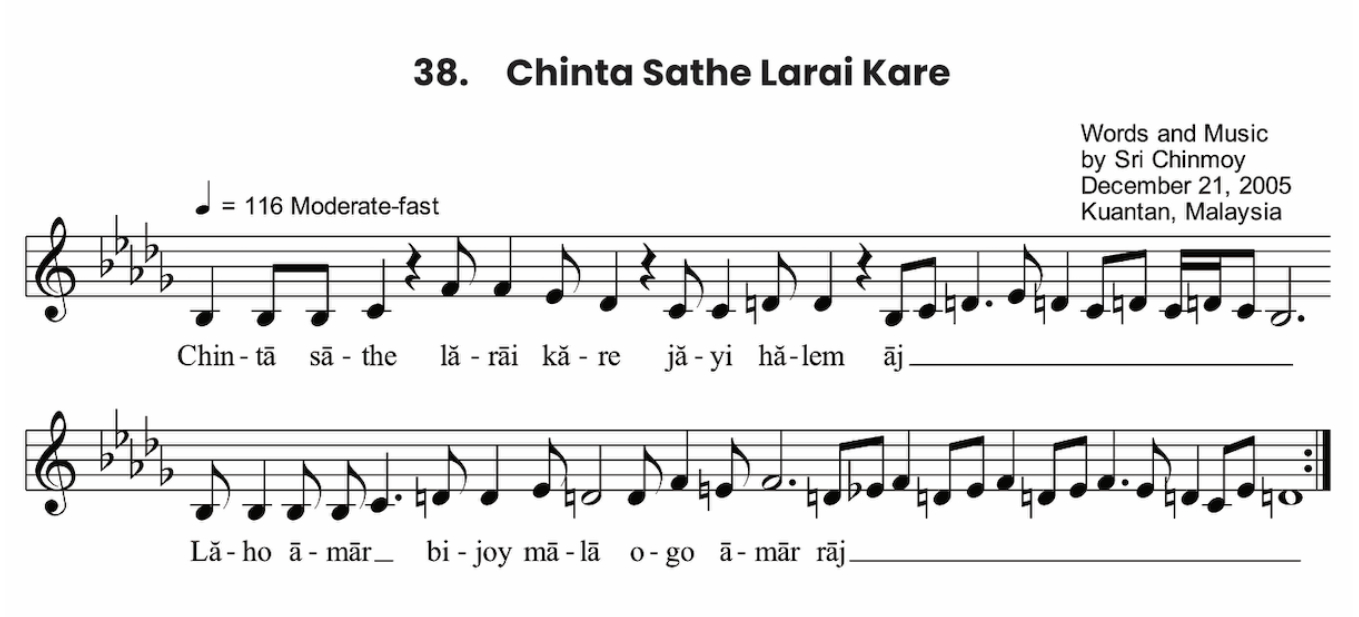
Chintā sāthe lărāi kăre jăyi hălem āj
Lăho āmār bijoy mālā ogo āmār rāj
Shuni Shuni Pran Gabhire Kanur Nupur Dhwani

Shuni shuni prān găbhire Kānur nupur dhwăni
Āmi hăte chāhi Kānur părăm năyăn măni
_Notes Songs "Shuni Shuni Pran Gabhire Kanur Nupur Dhwani” and "I Hear, I Hear Krishna’s Jingling Ankle Bells” were composed as a related pair, intended to be sung together, with the English immediately following the Bengali.<html></div></html> <html>
</html>
I Hear, I Hear Krishna’s Jingling Ankle Bells

I hear, I hear Krishna’s jingling ankle bells.
I long to be Krishna’s darling.
_Notes Songs "Shuni Shuni Pran Gabhire Kanur Nupur Dhwani” and "I Hear, I Hear Krishna’s Jingling Ankle Bells” were composed as a related pair, intended to be sung together, with the English immediately following the Bengali.<html></div></html> <html>
</html>
Dakite Chahina Kandite Chahina

Dākite chāhinā kāndite chāhinā
Chāhi shudhu tăbă chărăn dhărite
_Notes Songs "Dakite Chahina Kandite Chahina” and "I Know Not How to Invoke” were composed as a related pair, intended to be sung together, with the English immediately following the Bengali.<html></div></html> <html>
</html>
I Know Not How to Invoke

I know not how to invoke,
I know not how to cry,
I know only how to catch Your Feet.
_Notes Songs "Dakite Chahina Kandite Chahina” and "I Know Not How to Invoke” were composed as a related pair, intended to be sung together, with the English immediately following the Bengali.<html></div></html> <html>
</html>
Bhule Jai Bhule Jai Dyuloker Ashirvad

Bhule jāi bhule jāi dyuloker āshirvād
Tāi morā dibānishi kări shudhu ăpărādh
_Notes Songs "Bhule Jai Bhule Jai Dyuloker Ashirvad” and "We Forget, We Forget Heaven’s Blessings” were composed as a related pair, intended to be sung together, with the English immediately following the Bengali.<html></div></html> <html>
</html>
We Forget, We Forget Heaven’s Blessings

We forget, we forget Heaven’s Blessings.
Therefore, day and night we make blunders.
_Notes Songs "Bhule Jai Bhule Jai Dyuloker Ashirvad” and "We Forget, We Forget Heaven’s Blessings” were composed as a related pair, intended to be sung together, with the English immediately following the Bengali.<html></div></html> <html>
</html>
Kamana Basana Diye Bendechi Amar Pran
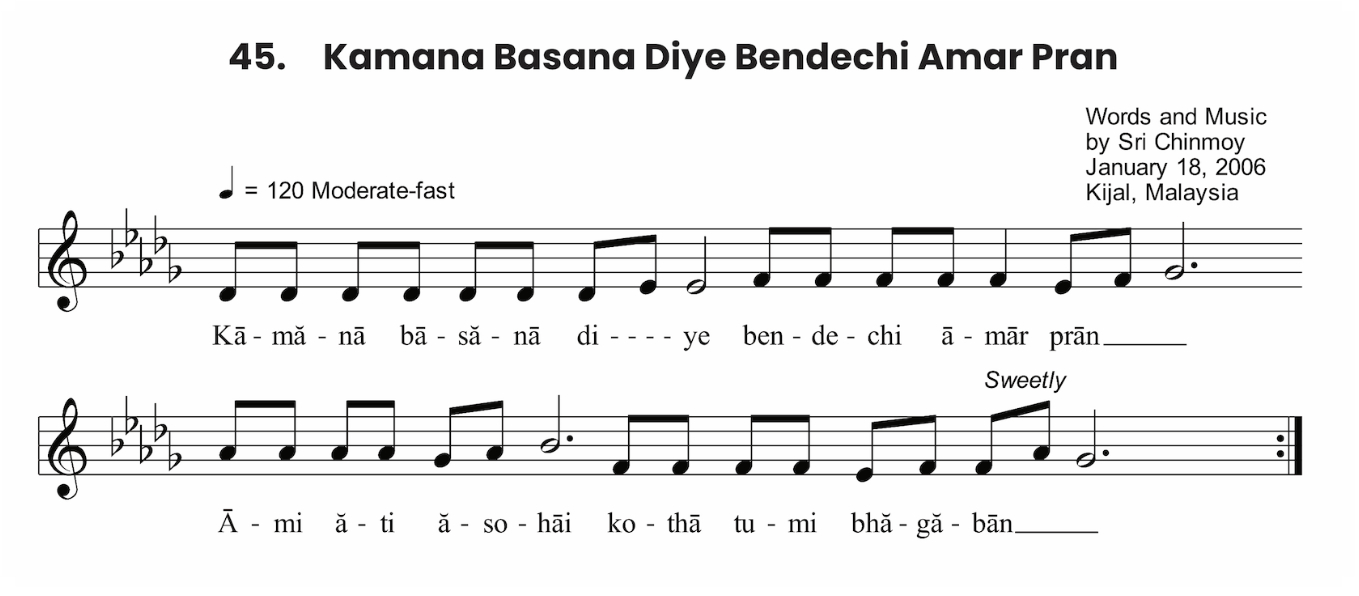
Kāmănā bāsănā diye bendechi āmār prān
Āmi ăti ăsohāi kothā tumi bhăgăbān
Janma Mrittyu Swarga Martya
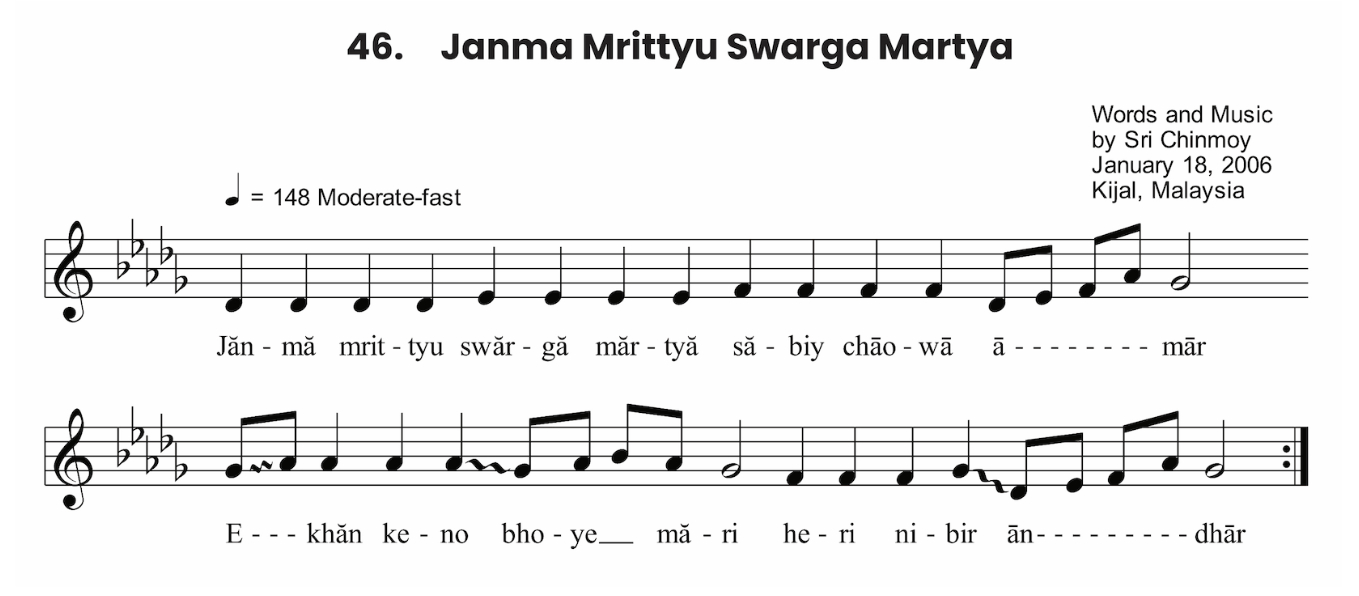
Jănmă mrittyu swărgă mărtyă săbiy chāowā āmār
Ekhăn keno bhoye mări heri nibir āndhār
Surjya Loker Amna Sabai Dipti Jatri
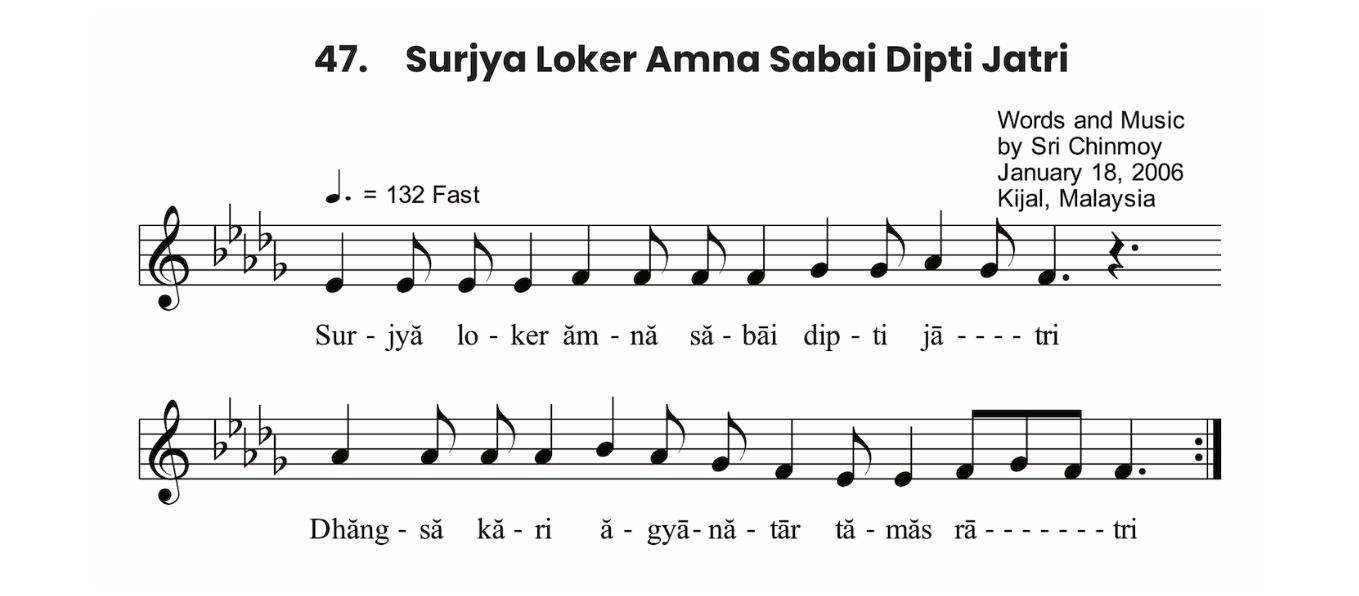
Surjyă loker ămnă săbāi dipti jātri
Dhăngsă kări ăgyānătār tămăs rātri
Kandite Hasite Asi Nai Ar Ei Dharanite
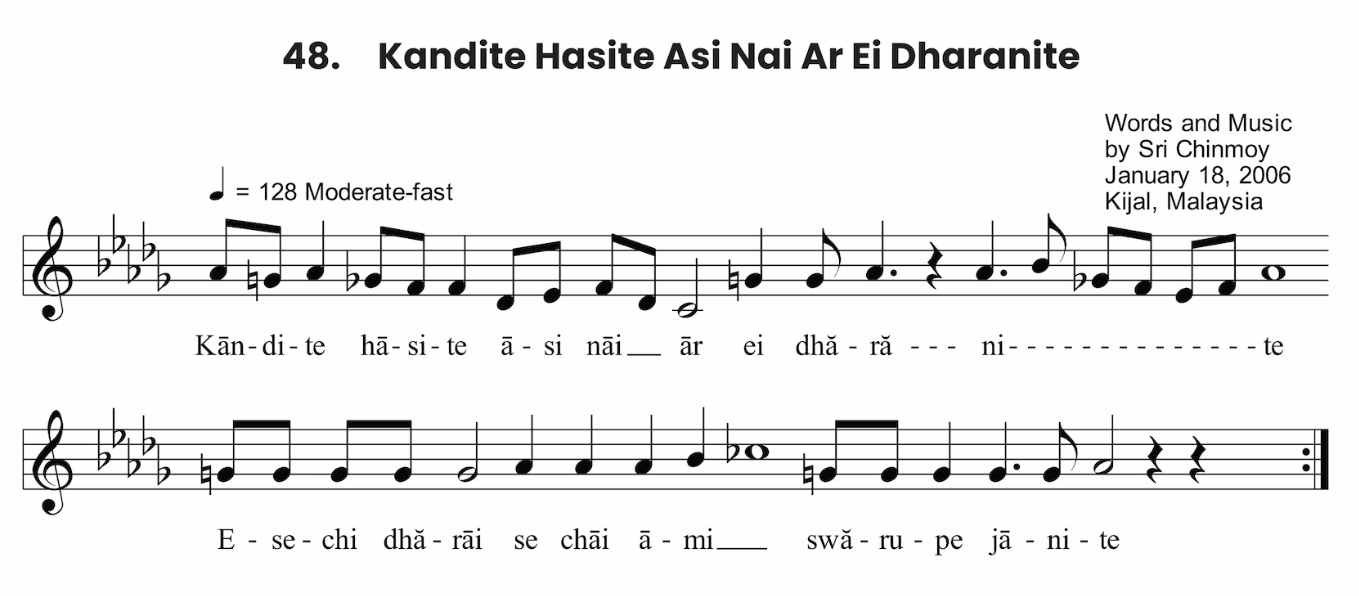
Kāndite hāsite āsi nāi ār ei dhărănite
Esechi dhărāi se chāi āmi swărupe jānite
Janite Chahina Amar Mrittyu Dibas

Jānite chāhinā āmār mrittyu dibăs
Chāhi shudhu āmi tomār chărăn părăsh
Dekhite chāhinā āmār mrittyu dibăs
Chāhi shudhu āmi tomār ămiyă hărăsh
_Notes Songs "Janite Chahina Amar Mrittyu Dibas” and "I Do Not Want to Know the Day” were composed as a related pair, intended to be sung together, with the English immediately following the Bengali.<html></div></html> <html>
</html>
I Do Not Want to Know the Day

I do not want to know
The day of my final earth-departure.
I long to feel only the Touch of Your Feet.
I do not want to see
The day of my final earth-departure.
I long to see only Your Nectar-Thrill.
_Notes Songs "Janite Chahina Amar Mrittyu Dibas” and "I Do Not Want to Know the Day” were composed as a related pair, intended to be sung together, with the English immediately following the Bengali.<html></div></html> <html>
</html>
Bhango... Bhango Amar Supti Ghor

Bhāngo bhāngo bhāngo bhāngo āmār supti ghor
Dāke more dāke more năbin ushār bhor
_Notes Songs "Bhango… Bhango Amar Supti Ghor” and "Break… Break My Darkness-Sleep” were composed as a related pair, intended to be sung together, with the English immediately following the Bengali.<html></div></html> <html>
</html>
Break… Break My Darkness-Sleep

Break, break, break, break
My darkness-sleep.
I am beckoned, I am beckoned
By the new dawn deep.
_Notes Songs "Bhango… Bhango Amar Supti Ghor” and "Break… Break My Darkness-Sleep” were composed as a related pair, intended to be sung together, with the English immediately following the Bengali.<html></div></html> <html>
</html>
Punya Bina Purna Jiban Asambhab

Punyă binā purnă jibăn ăsămbhăb
Ăgyānătār ăsārătār kălărăb
_Notes Songs "Punya Bina Purna Jiban Asambhab” and "No Virtues, No Light-Flooded Life” were composed as a related pair, intended to be sung together, with the English immediately following the Bengali.<html></div></html> <html>
</html>
No Virtues, No Light-Flooded Life

No virtues, no light-flooded life.
It is just wild cacophony.
_Notes Songs "Punya Bina Purna Jiban Asambhab” and "No Virtues, No Light-Flooded Life” were composed as a related pair, intended to be sung together, with the English immediately following the Bengali.<html></div></html> <html>
</html>
Consciousness-Bliss in Infinite Measure
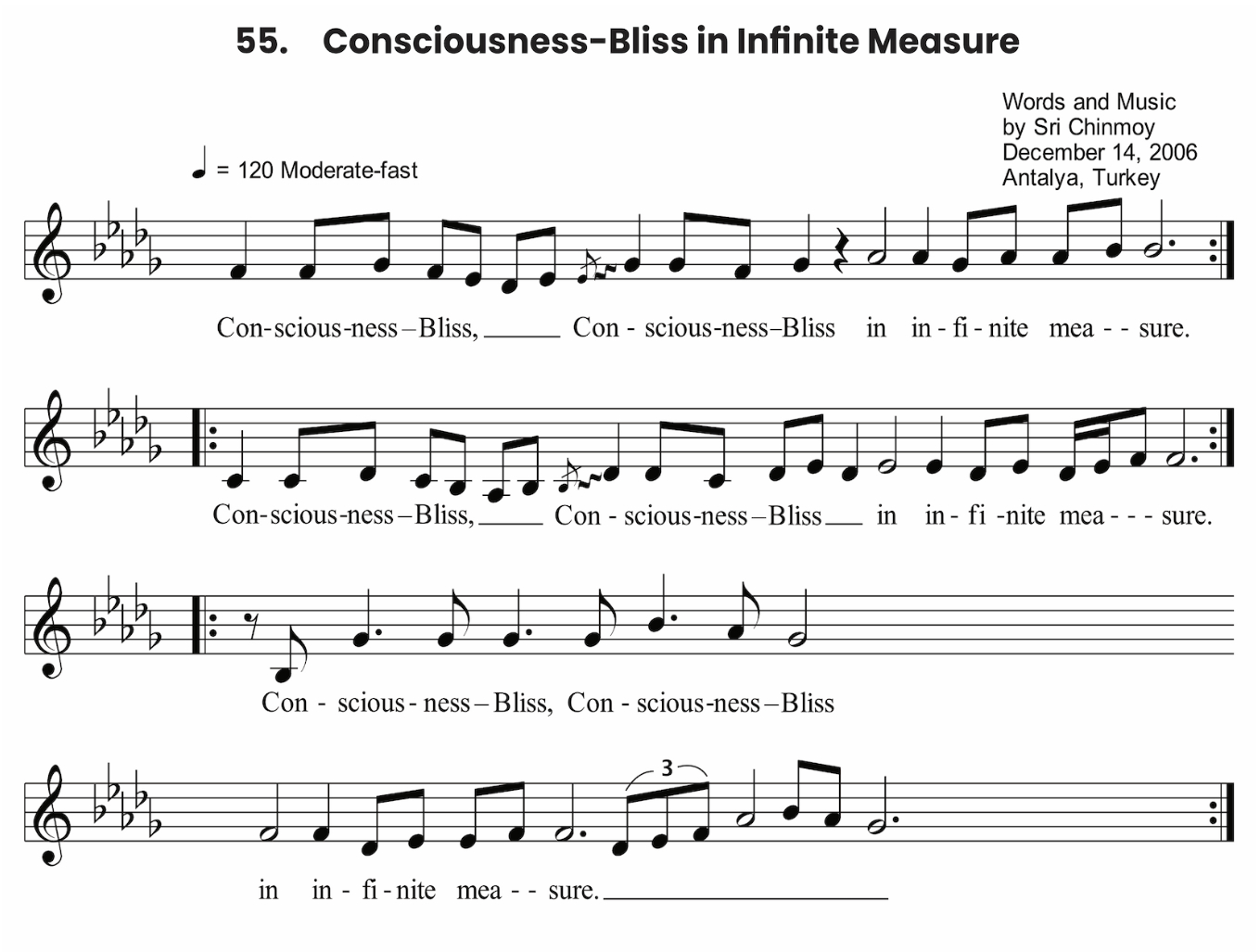
Consciousness-Bliss, Consciousness-Bliss
In infinite measure.
If You Want to Become

If you want to become a world redeemer,
Then be as cool as a cucumber.
_Notes This is one of a series of 20 songs in which Sri Chinmoy incorporates English idiomatic expressions into the lyrics. In this case: ‘cool as a cucumber’.<html></div></html> <html>
</html>
I Developed Cold Feet

I developed cold feet
When I saw my Master's Volcano-Face,
But my Master grabbed me
And gave me a fond embrace.
_Notes This is one of a series of 20 songs in which Sri Chinmoy incorporates English idiomatic expressions into the lyrics. In this case: ‘cold feet’. Note: Sri Chinmoy often used the word “Master” to refer to God, the Supreme.<html></div></html> <html>
</html>
I Enjoy Cock-and-Bull Stories

I enjoy cock-and-bull stories.
They bring to the fore my old, forgotten glories.
_Notes This is one of a series of 20 songs in which Sri Chinmoy incorporates English idiomatic expressions into the lyrics. In this case: ‘cock-and-bull stories’.<html></div></html> <html>
</html>
The World Defiles Me

The world defiles me,
But my Master wants to clear my name.
He tells the world
I am a spotless and matchless player in His Cosmic Game.
_Notes This is one of a series of 20 songs in which Sri Chinmoy incorporates English idiomatic expressions into the lyrics. In this case: ‘clear my name’. Note: Sri Chinmoy often used the word “Master” to refer to God, the Supreme.<html></div></html> <html>
</html>
I Fear Not to Mention

I fear not to mention
This world itself is a burning question.
_Notes This is one of a series of 20 songs in which Sri Chinmoy incorporates English idiomatic expressions into the lyrics. In this case: ‘burning question’.<html></div></html> <html>
</html>
I Have a Heart

I have a heart; others’ hearts I feel.
How can I bring anyone to heel?
_Notes This is one of a series of 20 songs in which Sri Chinmoy incorporates English idiomatic expressions into the lyrics. In this case: ‘bring to heel’.<html></div></html> <html>
</html>
Each Human Being Is My Bosom Friend

Each human being is my bosom friend.
Therefore, I can easily blend.
_Notes This is one of a series of 20 songs in which Sri Chinmoy incorporates English idiomatic expressions into the lyrics. In this case: ‘bosom friend’.<html></div></html> <html>
</html>
Barking Dogs Seldom Bite

Barking dogs seldom bite,
But they can bring down
Our consciousness-height.
_Notes This is one of a series of 20 songs in which Sri Chinmoy incorporates English idiomatic expressions into the lyrics. In this case: ‘barking dogs seldom bite’. This particular expression is also a proverb.<html></div></html> <html>
</html>
Every Day at the Crack of Dawn

Every day at the crack of dawn,
God knocks at my heart-door and tells me,
“My child, sleep no more.
Sail your life-boat to the Golden Shore.”
_Notes This is one of a series of 20 songs in which Sri Chinmoy incorporates English idiomatic expressions into the lyrics. In this case: ‘at the crack of dawn’.<html></div></html> <html>
</html>
You Are Ahead of the Times

You are ahead of the times
If you claim to belong to all the climes.
_Notes This is one of a series of 20 songs in which Sri Chinmoy incorporates English idiomatic expressions into the lyrics. In this case: ‘ahead of the times’.<html></div></html> <html>
</html>
How Can Anybody Enjoy

How can anybody enjoy
A constant heart-thrill,
Since he knows well that he, too,
Has an Achilles heel?
_Notes This is one of a series of 20 songs in which Sri Chinmoy incorporates English idiomatic expressions into the lyrics. In this case: ‘Achilles heel’.<html></div></html> <html>
</html>
I Am All Eyes

I am all eyes, I am all eyes,
In my heart-sky when my Master flies.
_Notes This is one of a series of 20 songs in which Sri Chinmoy incorporates English idiomatic expressions into the lyrics. In this case: ‘I am all eyes’. Note: Sri Chinmoy often used the word “Master” to refer to God, the Supreme.<html></div></html> <html>
</html>
I Am All Ears

I am all ears, I am all ears,
When my Master gives me thunder-cheers.
_Notes This is one of a series of 20 songs in which Sri Chinmoy incorporates English idiomatic expressions into the lyrics. In this case: ‘I am all ears’. Note: Sri Chinmoy often used the word “Master” to refer to God, the Supreme.<html></div></html> <html>
</html>
All Is Fair in Love and War

All is fair in love and war,
But God leaves you, to be far, very far.
_Notes This is one of a series of 20 songs in which Sri Chinmoy incorporates English idiomatic expressions into the lyrics. In this case: ‘all is fair in love and war’. This particular expression is also a proverb.<html></div></html> <html>
</html>
Only When You Are

Only when you are in God's special Care
You can be as free as air.
_Notes This is one of a series of 20 songs in which Sri Chinmoy incorporates English idiomatic expressions into the lyrics. In this case: ‘free as air’.<html></div></html> <html>
</html>
More and More Ignorance-Seeds I Gather

More and more ignorance-seeds I gather
Because I am a bird of a different feather.
_Notes This is one of a series of 20 songs in which Sri Chinmoy incorporates English idiomatic expressions into the lyrics. In this case: ‘a bird of a different feather’.<html></div></html> <html>
</html>
A Friend in Need

A friend in need is a friend indeed.
Our secret and sacred life-stories we gladly and proudly read.
_Notes This is one of a series of 20 songs in which Sri Chinmoy incorporates English idiomatic expressions into the lyrics. In this case: ‘a friend in need is a friend indeed’. This particular expression is also a proverb.<html></div></html> <html>
</html>
Arise with the Lark

Arise with the lark, arise with the lark.
Yours will be the life of the brightest spark.
_Notes This is one of a series of 20 songs in which Sri Chinmoy incorporates English idiomatic expressions into the lyrics. In this case: ‘arise with the lark’.<html></div></html> <html>
</html>
Half a Loaf Is Better Than None

Half a loaf is better than none.
Know this; lo, wisdom-medal you have won.
_Notes This is one of a series of 20 songs in which Sri Chinmoy incorporates English idiomatic expressions into the lyrics. In this case: ‘half a loaf is better than none’. This particular expression is also a proverb.<html></div></html> <html>
</html>
My Lord, Do Have a Change of Heart

My Lord, do have a change of heart.
I shall this time conquer ignorance-dart.
_Notes This is one of a series of 20 songs in which Sri Chinmoy incorporates English idiomatic expressions into the lyrics. In this case: ‘a change of heart’.<html></div></html> <html>
</html>
Otiant: Idle
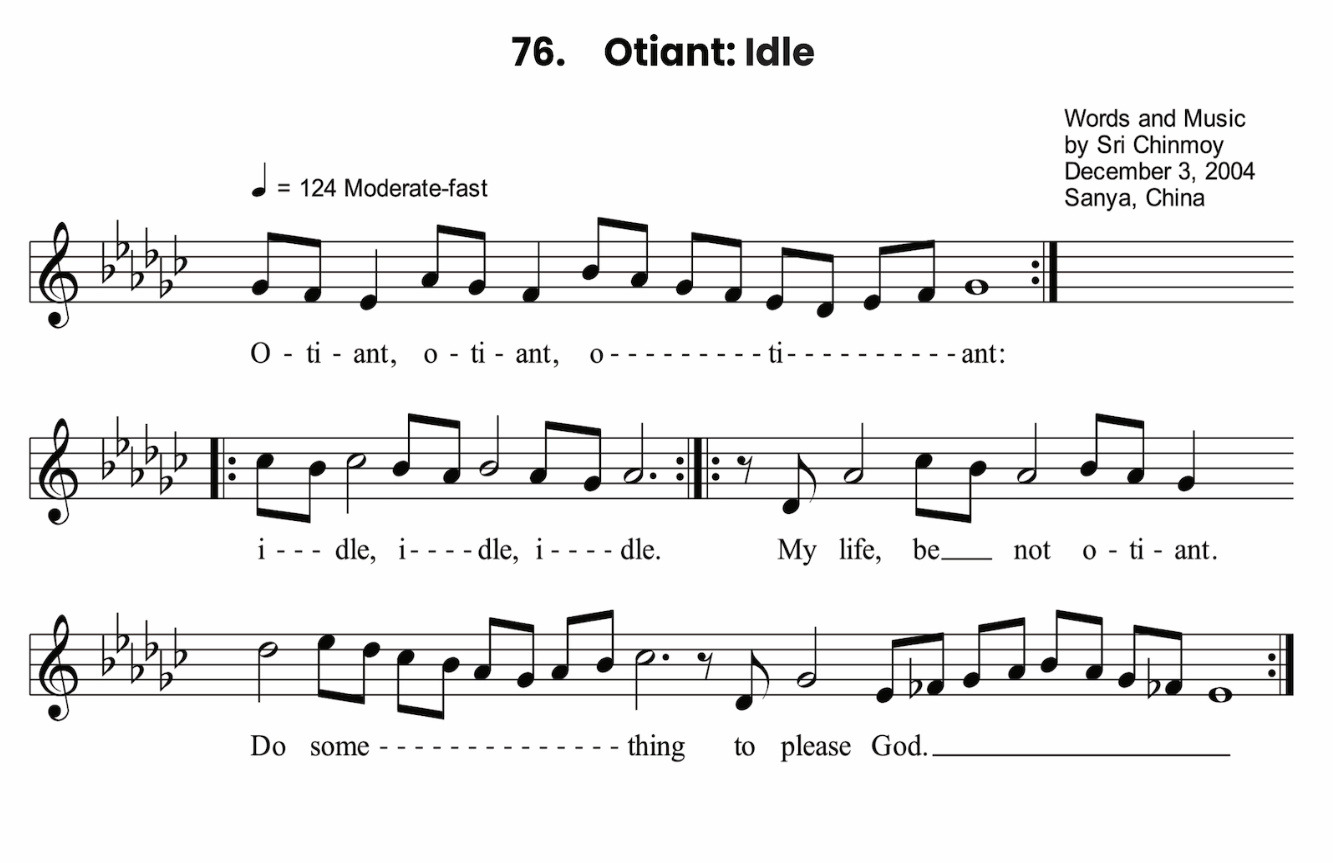
Otiant, otiant, otiant:
Idle, idle, idle.
My life, be not otiant.
Do something to please God.
Inanition: Emptiness
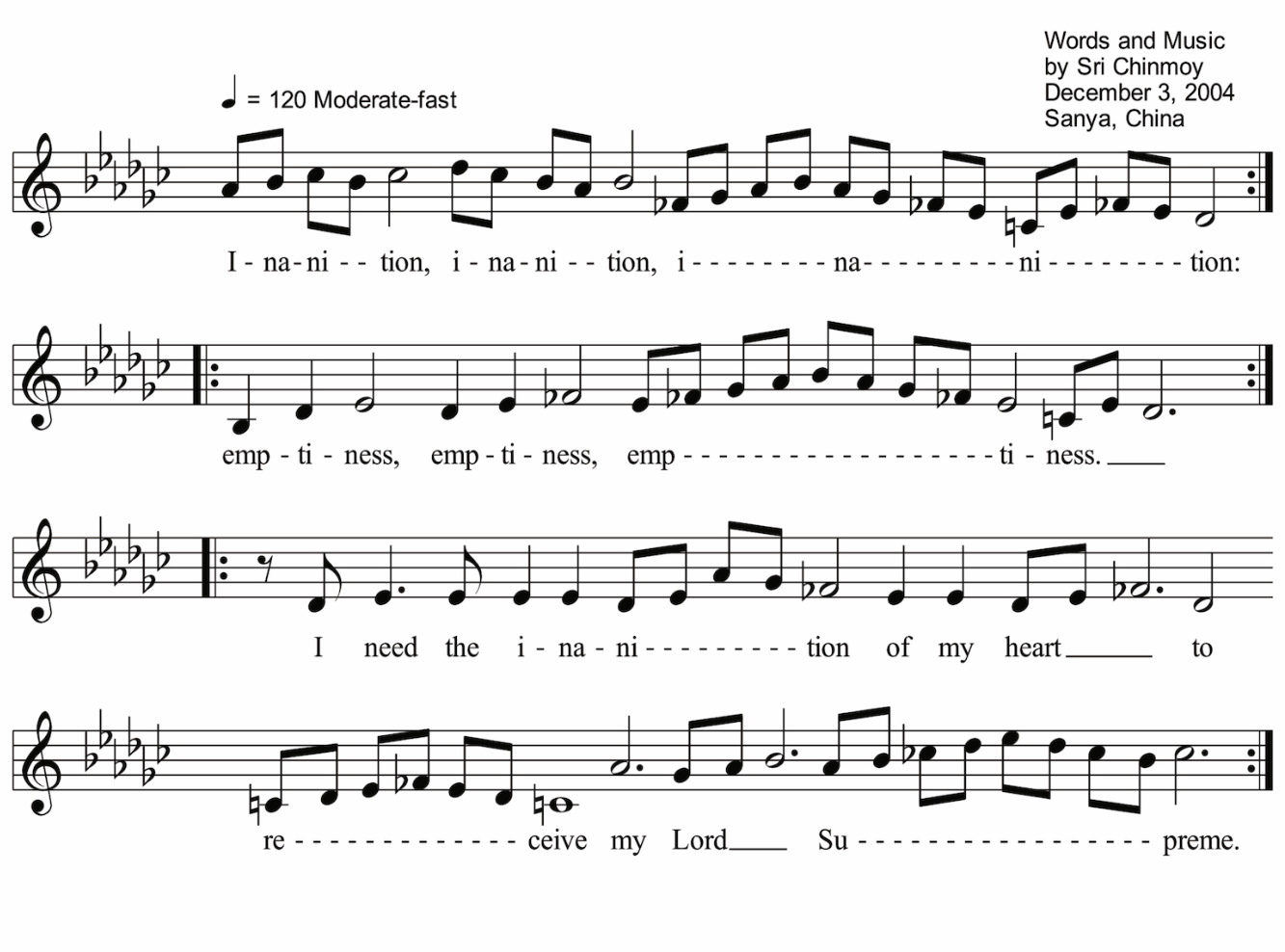
Inanition, inanition, inanition:
Emptiness, emptiness, emptiness.
I need the inanition of my heart
To receive my Lord Supreme.
Powerful Blessings from the English Soul, Set 1

i. Apogee
ii. Aplomb
iii. Disport
iv. Prate
v. Exhort
vi. Contravene
vii. Apocryphal
_Notes (Seven vocabulary words)<html></div></html> <html>
</html>
Powerful Blessings from the English Soul, Set 2

i. Slake
ii. Quell
iii. Parley
iv. Marauder
v. Guffaw
vi. Inane
vii. Countermand
_Notes (Seven vocabulary words)<html></div></html> <html>
</html>
Powerful Blessings from the English Soul, Set 3

i. Ingrate
ii. Servile
iii. Presage
iv. Importune
v. Melee
vi. Fain
vii. Affrontery
_Notes (Seven vocabulary words) It should be noted that the Oxford English Dictionary, among others, lists ‘affrontery’ as being an archaic English word. Sri Chinmoy used the similar, current word ‘effrontery’ (different meaning) a number of times in his writings, and also in one of his earlier vocabulary songs published in the songbook, Come, My Non-English Speaking Friends. Let us Together Climb Up the English Himalayas, Part 1 (Song<html></div></html> <html>
</html>
Three Additional Vocabulary Songs
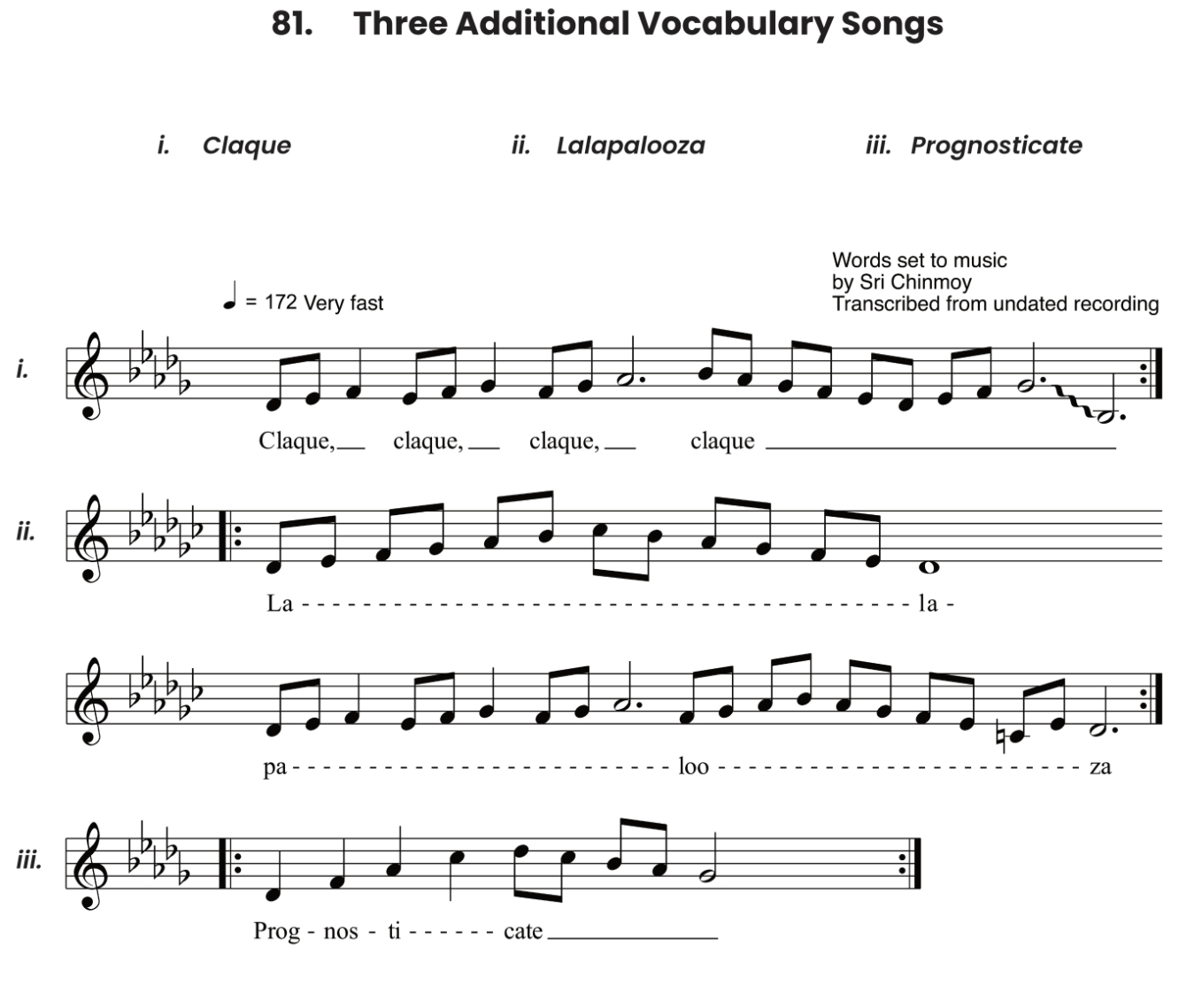
i. Claque
ii. Lalapalooza
iii. Prognosticate
Come – Eso (revised)

Come, come, come, come, come, come, come —
Eso eso eso eso eso eso
_Notes Songs “Come – Eso” and “Sit – Baso” were composed as a related pair intended to be sung together, one after the other. Previous versions were published in Paramer Mahatripti Songbook (2005, songs<html></div></html> <html>
</html>
Sit – Baso (revised)

Sit, sit, sit, sit, sit —
Băso băso băso băso băso băso
_Notes Songs “Come – Eso” and “Sit – Baso” were composed as a related pair intended to be sung together, one after the other. Previous versions were published in Paramer Mahatripti Songbook (2005, songs<html></div></html> <html>
</html>
Ami Asi – I Come (revised)

Āmi āsi āmi āsi āmi āsi —
I come, I come, I come.
_Notes Songs “Ami Asi – I Come” and “Ami Bhalobasi – I Love” were composed as a related pair intended to be sung together, one after the other. Previous versions were published in Paramer Mahatripti Songbook (2005, songs<html></div></html> <html>
</html>
Ami Bhalobasi – I Love

Āmi bhālobāsi āmi bhālobāsi āmi bhālobāsi —
I love, I love, I love, I love.
_Notes Songs “Ami Asi – I Come” and “Ami Bhalobasi – I Love” were composed as a related pair intended to be sung together, one after the other. Previous versions were published in Paramer Mahatripti Songbook (2005, songs<html></div></html> <html>
</html>
Jatri – Pilgrim (revised/rewritten)

Jātri jātri jātri jātri jātri jātri jātri —
Pilgrim, pilgrim, pilgrim, pilgrim, pilgrim, pilgrim, pilgrim.
_Notes Songs “Jatri – Pilgrim” and “Ratri – Night” were composed as a related pair intended to be sung together, one after the other. Previous versions were published in Paramer Mahatripti Songbook (2005, songs<html></div></html> <html>
</html>
Ratri – Night (revised)

Rātri rātri rātri rātri rātri rātri —
Night, night, night, night, night.
_Notes Songs “Jatri – Pilgrim” and “Ratri – Night” were composed as a related pair intended to be sung together, one after the other. Previous versions were published in Paramer Mahatripti Songbook (2005, songs<html></div></html> <html></div> </div> </div> </html> <html>
<ul class="actions"> <li><a href="/print/cbs" target="_blank" id="print">Printer-friendly view</a></li> <li><a href="/cbs" id="toc">Table of contents</a></li> <li><a href="https://www.vasudevaserver.org/contact/report-issue/" target="_blank">Report typographical errors</a></li> </ul>
This book can be cited using cite-key <a href="/cbs">cbs</a>
<a rel="license" href="/about#copyright"><img alt="Creative Commons License" style="border-width:0" src="https://licensebuttons.net/l/by-nc-nd/4.0/88x31.png"/></a><br/>This work is licensed under <a rel="license" href="/about#copyright">Creative Commons Attribution-NonCommercial-NoDerivs 4.0 Unported License</a>.

</html>