Depend on Grace
Meetings with Luminaries
Ravi Shankar, Legendary Indian Sitarist
Presentation of the U Thant Peace AwardOn 20 September 2002, Sri Chinmoy honoured Ravi Shankar, the legendary Indian sitar player, in San Diego, California. Ravi Shankar was accompanied by his wife, Sukanya, and his daughter, Anoushka. To begin the evening, Sri Chinmoy read out the English translation to “Bindu eseche sindhu duare”, a Bengali song he had composed dedicated to the Maestro:
A drop has arrived at the heart-door of the ocean To receive affection and compassion from the ocean. Ravi Shankar, Sri Chinmoy is absolutely enamoured Of your nectar-flooded music.
Sri Chinmoy then performed the song and garlanded Ravi Shankar. Afterwards, Sri Chinmoy chanted in Sanskrit:
Asato ma sad gamaya.
Tamaso ma jyotir gamaya.
Mrityor ma amritam gamaya.
(Lead me from the unreal to the Real.
Lead me from darkness unto Light.
Lead me from death to Immortality.) 1
Sri Chinmoy then presented the U Thant Peace Award with the following remarks.
Sri Chinmoy: My highly esteemed friend, Ravi Shankar, and my deeply affectionate brother Ravi-da, my aspiration-heart and my dedication-life are telling me that every single day your colossal music-soul swiftly travels the universe and prayerfully gathers a huge bouquet of twinkling stars to place at the Feet of the Absolute Lord Beloved Supreme. His Joy and Pride in you are far beyond the flights of our imagination.
In the inner world, an irresistible music you are. In the outer world, a magnetic musician you are. No hyperbole, your music not only elevates our consciousness high, very high, very, very high, but also intensifies our aspiration deep, very deep, very, very deep. Something more, to our greatest delight, we see divinity streaming from your God-dreaming eyes, lightning-speed fingers and towering confidence-hands and arms.
When a God-seeker listens to your music, he in no time is blessed with a rare capacity to invoke joy, to breathe in joy, to radiate joy and, finally, to become joy unfathomable.
The joy of the heart and the peace of life are inseparable. Ravi Shankar the divine musician and God the Supreme Musician sleeplessly communicate through the language of love. This love is at once the Beauty of God’s universal Peace and the Fragrance of God’s transcendental Bliss.
Ravi-da, Ravi Shankar, to be in your blessingful and music-flooded presence is to reclaim our own vast cheerful and blissful heart-kingdom.
We are all God’s sweet children of music in His Heart-Garden. Alas, we have buried this infallible truth in stark oblivion. But you, Ravi Shankar, musician nonpareil, are the reassuring whisper that echoes and re-echoes in our hearts with God’s Message supreme: “We are all God’s sweet children of music.”
Here we are perpetuating the memory of U Thant, the third Pilot Supreme of the United Nations Boat, whose very life was to spread the message of brotherhood, harmony and peace throughout the length and breadth of the world. While offering you the U Thant Peace Award, 2 our Meditation Group at the United Nations and I are swimming in the ocean of infinity’s Peace and Bliss.
Ravi Shankar (after receiving the U Thant Peace Award): Sri Chinmoy, my brother, I am so over-whelmed and emotionally I feel choked with the love that you have shown towards me and by this great honour that you have given me. I feel so grateful and proud, more so after I saw the giants and some of the greatest people that have received this before me, that have been given this wonderful Peace Award by you. I am very grateful, and I am full of love and gratitude. Thank you again, Sri Chinmoy.
Sri Chinmoy then honoured Ravi Shankar by lifting him overhead with one arm, and then lifted Ravi Shankar, Sukanya and Anoushka together as part of his “Lifting Up the World with a Oneness-Heart” programme. 3
Videos were then shown of Sri Chinmoy and his students singing his songs dedicated to Ravi Shankar.
Ravi Shankar’s parting words to the audience at the end of the function: You are so lucky to have him as your guide in life. And what wonderful work is being done! Please keep it up. We are all so tired of all the violence and all the negative things, all the discord that is happening. Amidst that, people like him and those who love him and follow him are doing wonderful work.
1. Traditional scripture, as quoted by Sri Chinmoy in The Upanishads: The Crown of India’s Soul. New York: Sri Chinmoy Lighthouse, 1974.↩
2. In honour of the third UN Secretary-General, starting in 1982, Sri Chinmoy presented the U Thant Peace Award on behalf of Sri Chinmoy: The Peace Meditation at the United Nations to individuals and organizations who, in exemplifying the lofty spiritual ideals of the late UN Secretary-General, offered distinguished service toward the attainment of world peace.↩
3. Sri Chinmoy was an avid sportsman from his youth and throughout his life. He took up weightlifting in the mid-1980s, and subsequently honoured numerous individuals with the “Lifting Up the World with a Oneness-Heart” Award. As a sign of his deepest appreciation for their inspiring contributions to humanity, Sri Chinmoy would raise these individuals overhead with one arm from a special honorary platform – just as a star player at a sports event is lifted up by his grateful teammates.↩
Ravi Shankar
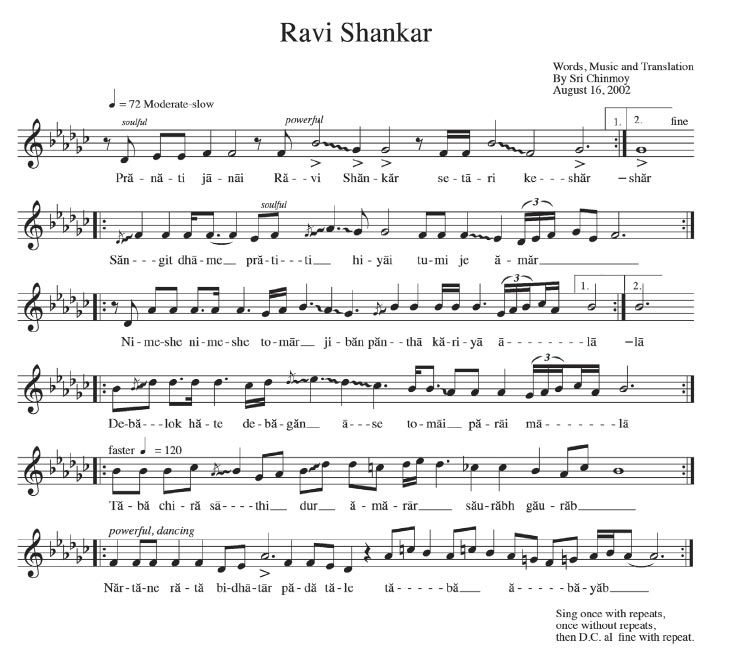
Pranati janai Ravi Shankar setari keshar
Sangit dhame pratiti hiyai tumi je amar
Nimeshe nimeshe tomar jiban pantha kariya ala
Debalok hate debagan ase tomai parai mala
Taba chira sathi dur amarar saurabh gaurab
Nartane rata bidhatar pada tale taba abayab
Ravi Shankar, to you I offer my soulful obeisance.
You are the Lion-Sitarist.
In the world of hallowed music-pilgrimage,
Immortal you are in every heart.
From high Heaven the Cosmic Gods descend and garland you.
At every moment they illumine your life-road.
Two sleepless friends you have: Heaven's Fragrance, Heaven's Glory.
Rapt in dance at the Feet of the Absolute Lord Supreme
Is your outer frame.
Ravi Shankar: The Lion-Sitarist
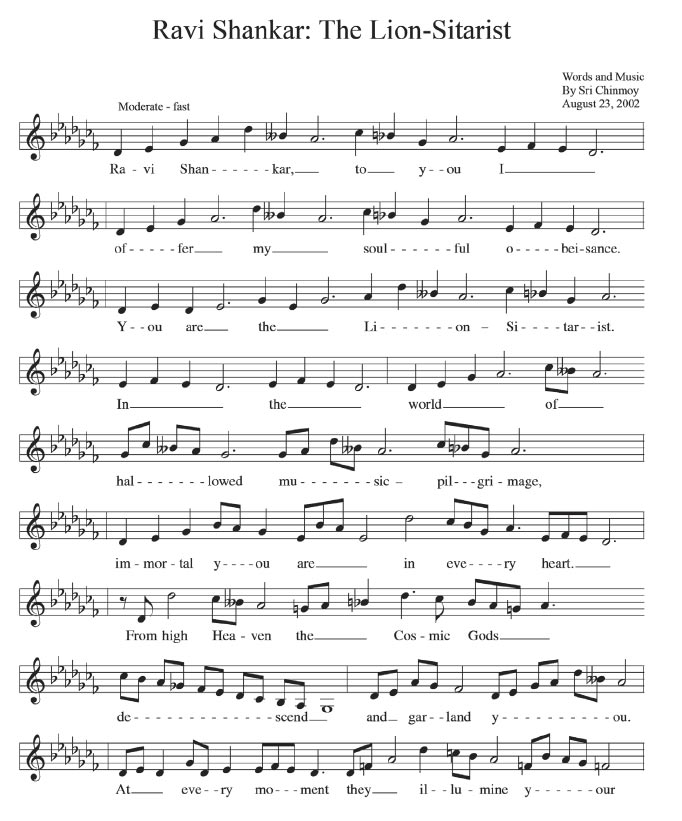
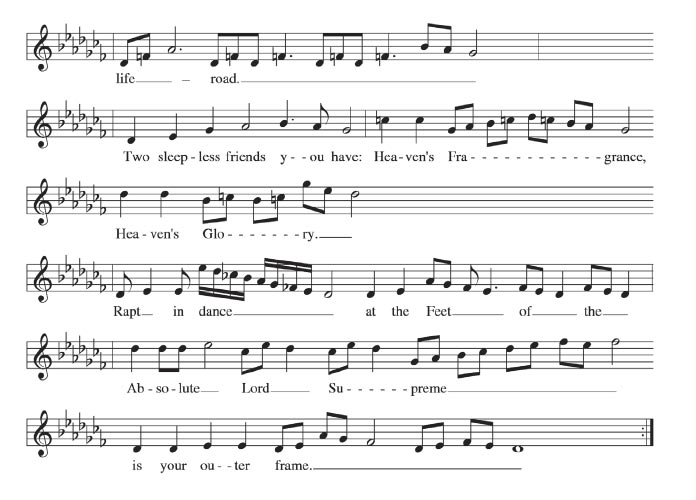
Ravi Shankar, to you I offer my soulful obeisance.
You are the Lion-Sitarist.
In the world of hallowed music-pilgrimage,
Immortal you are in every heart.
From high Heaven the Cosmic Gods descend and garland you.
At every moment they illumine your life-road.
Two sleepless friends you have: Heaven's Fragrance, Heaven's Glory.
Rapt in dance at the Feet of the Absolute Lord Supreme
Is your outer frame.
Bindu Eseche
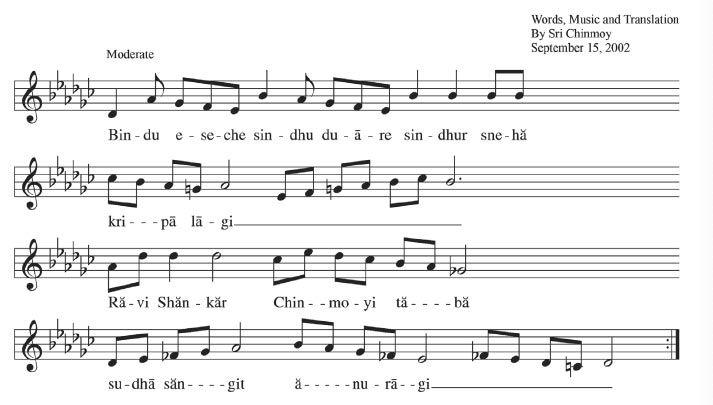
Bindu eseche sindhu duare sindhur sneha kripa lagi
Ravi Shankar Chinmoyi taba sudha sangit anuragi
A drop has arrived at the heart-door of the ocean
To receive affection and compassion from the ocean.
Ravi Shankar, Sri Chinmoy is absolutely enamoured
Of your nectar-flooded music.
I Have Given the West
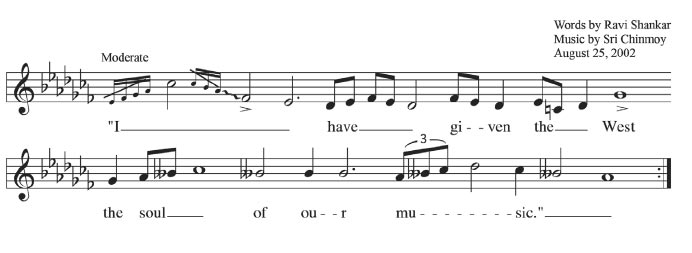
“I have given the West the soul of our music.”
– Ravi Shankar
I Always Feel I Am Not There Yet
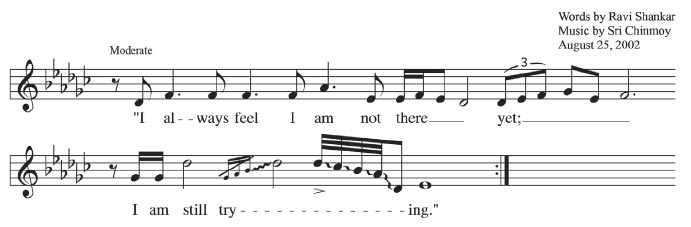
"I always feel I am not there yet; I am still trying."
– Ravi Shankar
The Highest Form in Music
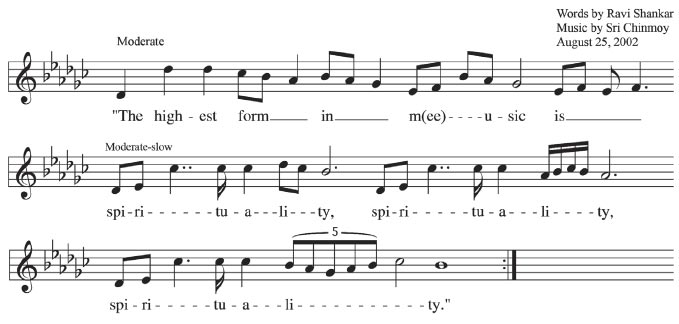
"The highest form in music is spirituality."
- Ravi Shankar
Visit to Paramahansa Yogananda’s Self-Realization Fellowship
On 21 September 2002, at Ravi Shankar’s invitation, Sri Chinmoy and his students visited the Paramahansa Yogananda Self-Realization Retreat and Hermitage in Encinitas, California. Also joining them was Olympic great Sudhahota Carl Lewis, a dear friend of Sri Chinmoy. 4For this occasion, Sri Chinmoy composed a new song for Paramahansa Yogananda about his book, Autobiography of a Yogi, for the singers to perform. While teaching the song beforehand, Sri Chinmoy offered the following comment.
Sri Chinmoy: This is a song about his autobiography. Is there anybody who has not read it? I have read it thrice. It is an immortal book that has inspired millions of seekers – many divine things we learn from that book. Before you sing, please have very, very devoted feelings and try to get the lilt of the song.
The visit to the Retreat concluded with these parting words between Ravi Shankar and Sri Chinmoy:
Ravi Shankar: Go on giving as much as you have been giving all the time.
Sri Chinmoy: I shall treasure in the inmost recesses of my heart your blessings, your blessing-light.
4. Sudhahota Carl Lewis, “Olympian of the Century,” who met Sri Chinmoy in 1983, offered his expertise to coach Sri Chinmoy in sprinting, and considered Sri Chinmoy as his spiritual coach.↩
Paramahansa He Yogananda
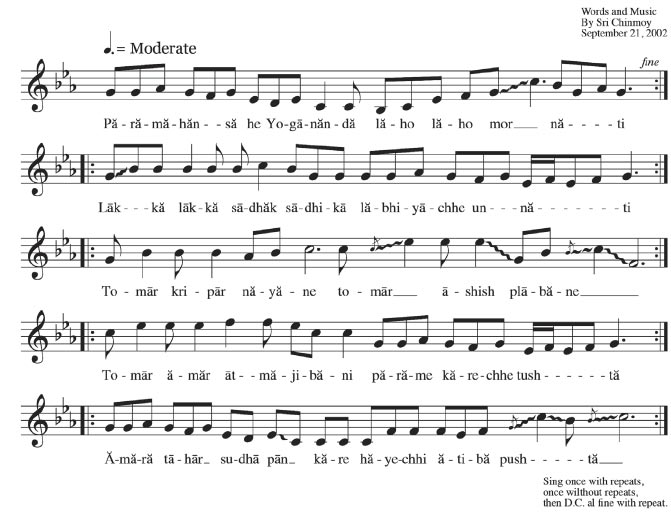
Paramahansa he Yogananda laho laho mor nati
Lakka lakka sadhak sadhika labhiyachhe unnati
Tomar kripar nayane tomar ashish plabane
Tomar amar atmajibani parame karechhe tushta
Amara tahar sudha pan kare hayechhi atiba pushtai
A Visit to New York
On 10 and 11 October 2002, Ravi Shankar, his wife Sukanya and daughter Anoushka visited Sri Chinmoy in New York. The two days of festivities included a function honouring the family the evening of 10 October, and culminated in a private concert offered by the Maestro and his daughter at Aspiration-Ground meditation garden the evening of 11 October.On 10 October 2002, before the evening function in their honour at Public School 86, Ravi Shankar and Sukanya were Sri Chinmoy’s guests at Annam Brahma Restaurant. Their conversation was mainly in Bengali, but following are excerpts from a few stories and comments in English.
Sri Chinmoy: I was a young boy many, many years ago when you played in Dilip Kumar Roy’s5 house at the Sri Aurobindo Ashram. I was only a matter of four or five metres away, right in front of you. I was fourteen or fifteen years old. Whoever imagined that we would be meeting like this so many years later?6 According to our philosophy, there is no such thing as impossibility. Now, when I am in your presence, I feel that, indeed, there is no such thing as impossibility. Everything is possible, everything is possible by God’s Grace.
Ravi Shankar: Thank you. That was a wonderful time I had at the Ashram. Two days I stayed there at Dilip Roy’s house.
Sri Chinmoy: Dilip had some problems with his throat, so Sri Aurobindo advised him not to sing anymore. When I was sixteen years old, I believe, I wrote a poem on Sri Aurobindo and the Mother. I had started writing poems at the age of twelve. To my great astonishment, Dilip liked the poem immensely. He came to my house early in the morning around nine o’clock with my poem. I do not even know how he got the poem. Although he was not supposed to sing, he started singing for me because he liked it so much. He was singing and singing, and then he was humming and singing under his breath. I could not believe my eyes, I could not believe my ears, that he would be so kind as to come to my place to sing! I still have that poem about the Mother and Sri Aurobindo.
Ravi Shankar (referring to an occasion when his elder brother Uday visited the Ashram but was not able to dance for Sri Aurobindo): Do you know any of Sri Aurobindo’s views, why he didn’t listen to music or see dance?
Sri Chinmoy: His philosophy is the acceptance of life and then the transformation of life. We accept life as it is now. Then we need transformation, transformation of the body, vital, mind and heart. But first we have to accept life as such, and then we have to transform it. That was his view, to bring down light from above.
Then for fifty years or so, he was in one main room. You can say that he practised sadhana, austerity. In his writings he has said, “You must accept life, accept life.” But in his day-to-day life, he renounced everything. He did not care for what was happening all around. But the Mother of the Sri Aurobindo Ashram manifested his philosophy. She accepted life – singing, dancing, everything. She herself used to play the organ. They were complementary souls. It is like the obverse and the reverse of the same coin. Mother took the work of manifestation, whereas Sri Aurobindo took the sadhana of realisation. He said, “Realise, realise the Highest,” and Mother said, “While realising the Highest, let us manifest. While going up, while climbing up the tree, if we see there are mangoes, let us pluck the mangoes and bring them down. Let people enjoy the mangoes.”
5. Dilip Roy, the famous Indian lyrical singer, lived in the Ashram; Sri Aurobindo called Dilip his dearest son.↩
6. As graciously arranged by legendary guitarist Mahavishnu John McLaughlin, Sri Chinmoy and Ravi Shankar also had a private meeting in the 1970s in New York, with the friendship between the two resuming many years later, in 2002.↩
7. Ravi Shankar’s older brother Uday is known as the father of modern Indian dance.↩
Function to Honour Maestro Ravi Shankar
On the evening of 10 October 2002, Sri Chinmoy and his students honoured Ravi Shankar and Sukanya. As part of the function, the singers performed an arrangement of a song Sri Chinmoy dedicated to their daughter, Anoushka. Towards the end of the function, Ravi Shankar made the following remarks.Ravi Shankar: Sri Chinmoy and all my friends here, I am so deeply moved that I don’t know what to say. I was just telling your Master that I realise how much he has worked to bring this glow in your faces. It’s not just the singing or your expressions through the words, but through your eyes, through your whole being – you all look so beautiful. And I think it is one of the greatest achievements, to be able to pass this to your students, to your disciples and fellow beings.
I deal only with musical notes, not words, and tomorrow I will try to express what I feel. I hope all of you will be there. I really – “congratulate” is not the right word – I really thank Sri Chinmoy for bringing this beautiful feeling into all your hearts. Thank you.
Following is the song Sri Chinmoy dedicated to Anoushka that the singers performed as an arrangement during the function, as well as two songs in which Sri Chinmoy set Anoushka’s words to music.
Dhanya Dhanya Ogo Anoushka
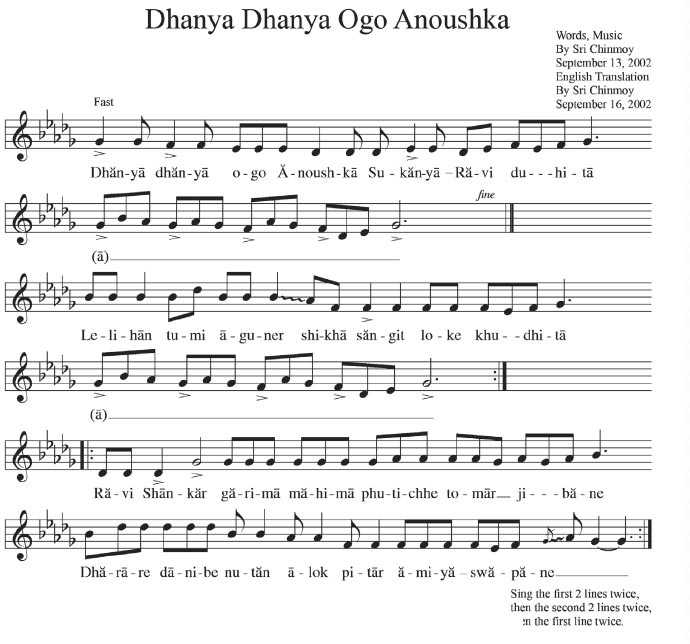
Lelihan tumi aguner shikha sangit loke khudita
Ravi Shankar garima mahima phutichhe tomar jibane
Dharare danibe nutan alok pitar Amiya-swapane
Blessed you are, blessed you are,
O Anoushka, Sukanya-Ravi’s fondness-child.
An ever-climbing and dazzling aspiration-flame
is your sleepless heart-hunger
in the world of music-light and delight.
Ravi Shankar’s loftiest achievements,
descending from the ever-transcending Beyond
are blossoming in your own music-heart-life.
With your soul-stirring music,
you will offer to the Comity of Nations
a supremely new, beautiful, powerful
and all-illumining light.
Your Father's nectar-flooded Dream is fast growing
into the inevitable Reality.
My Father
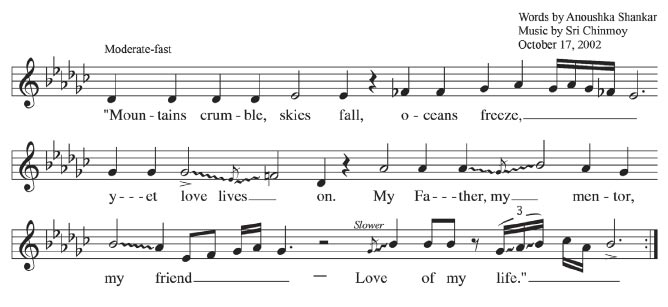
“Mountains crumble, skies fall,
oceans freeze, yet love lives on.
My Father, my mentor, my friend -
Love of my life.”
– Anoushka Shankar
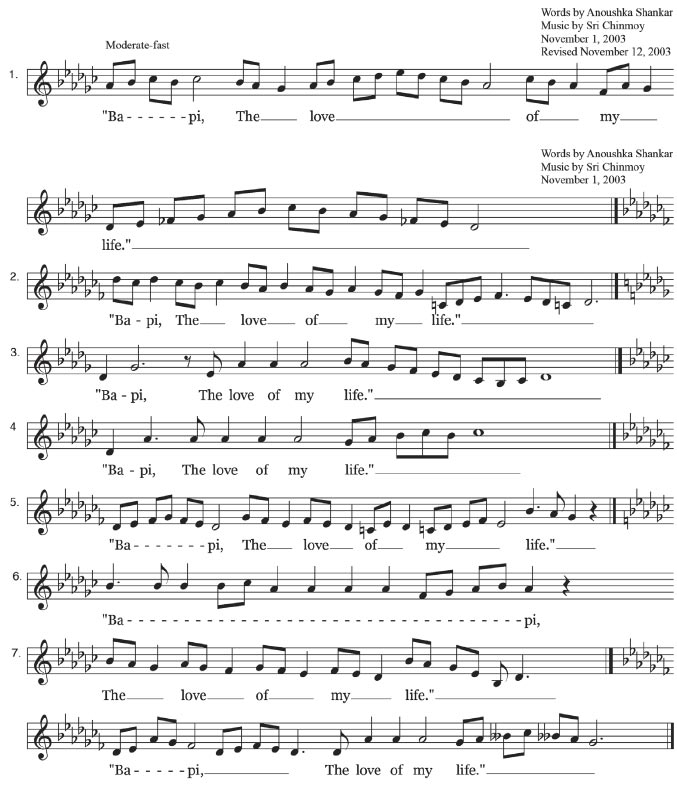
Bapi, The Love of My Life
Sri Chinmoy Comments
After Ravi Shankar and his wife left the function on 10 October 2002, Sri Chinmoy expressed his gratitude to the singers and musicians who had performed. Following are a few excerpts from additional comments.Sri Chinmoy: I am happy that a musician of the highest order has enjoyed our songs, music, recitations and everything that we have done. He enjoyed it very, very much, so I am very happy that we have got blessingful encouragement from such a great musician.
*
He wants my esraj to be called “Chinmoy Vina.” Two days ago I got my esraj from Sumadhur as his birthday present to me. Now Ravi Shankar’s wife, Sukanya, would like Sumadhur to make a sitar for her husband.
*
After the singers performed the arrangement of the song dedicated to his daughter, Anoushka, he used the Bengali word Abhutapurba, which means unprecedented.
He told me twice: “How hard you have worked with your disciples!”
*
Comment about writing songs in English and Bengali, after speaking about songs he had composed for Ravi Shankar in both English and Bengali:
I know the meaning of the English words. But somehow I cannot identify myself with the music that is inherent in the English words. In Bengali immediately I dive deep into the meaning of the word. But with English, I know the meaning well, I know what the words signify, but sometimes I cannot enter into them. Sometimes the melody I am getting, but from the words I am not getting the joy that I should get. If I take the melody separately, I will get joy. But with the words I find it very, very difficult.
Even the words, in English, “Supreme, I bow to Thee, I bow,” 8 when I say ‘bow’, the word ‘bow’ is so devotional. It is so full of devotion. But when I say the word namo, I derive much more joy from the word namo than the word ‘bow’. ‘Bow’ is part of our mantra: “I bow to Thee, I bow.” But when the Bengali word comes, I get more joy, more feeling, more feeling of oneness with namo than with ‘bow’. Namo is such a sweet word. I do not get the same joy from ‘bow’.
But again, ‘Supreme’ is my life-breath. That is why when I say ‘Supreme’, I get such joy and such height. There are so many Bengali words – Ishwara, Parama, Bhagaban, Prabhu and others – that mean ‘Supreme’. How soulfully you sing Bhulite diyona Prabhu, but I do not get the same joy when you say Prabhu as I get from ‘Supreme’ because ‘Supreme’ is my life-breath. That is why when you say ‘Supreme’, no matter how casually you say it, I get joy. I have established my inseparable oneness with the word ‘Supreme’. When you say ‘Supreme’, when you sing ‘Supreme’ soulfully, I feel that I have got everything and I have given everything. But with other words, I do not have this feeling. With ‘bow’ I do not get this feeling. With Ishwara, Parama, Prabhu and Parameshwar and all these, I do not get it. Even the word Bhagaban – which is in the heart, the life-breath of Indians – does not give me the same satisfaction as ‘the Supreme’. That is our mantra. This mantra has to be dearer than life itself.
8. Sri Chinmoy, My Flute, from the first two lines of the poem “Invocation”, which Sri Chinmoy also set to music and encouraged his students to sing every day. New York: Sri Chinmoy Lighthouse, 1972.↩
Special Concert by Maestro Ravi Shankar
The highlight of Ravi Shankar’s visit to New York was a private concert on the evening of 11 October 2002 offered by the Maestro and his daughter, Anoushka, at Aspiration-Ground. The enthusiastic standing-room-only audience included United Nations delegates and staff, as well as other invited guests.Before the concert, Sri Chinmoy read the following tribute to Ravi Shankar and Anoushka:
Ravi Shankar, to you I bow, to you I bow. When you play, your heart becomes a Heaven-climbing flame. When you play, you play in your golden heart-boat and your Inner Pilot speaks to you from His transcendental Summit. The silence-sound-music-waves of your eyes tell the audience that the only real hunger is the God-hunger. The Peace-Music of your inner world begins. The Bliss-Music of your outer world completes.
While playing, each time you smile at the audience, a new inspiration-aspiration-world blossoms. God examines you each time you play, whether it is a small gathering or a mammoth gathering, and you invariably pass all your examinations with flying colours. For the God-seekers and God-lovers, each time you play, it is indeed an inner wake-up call from God Himself. Each time you play, you unreservedly inspire us to drink deep Nectar-Delight far beyond this world.
Anoushka, my dear Anoushka, when you play, your aspiration-heart becomes a God-Beauty-revelation and your dedication-hands become a God-Duty-manifestation.
When you and your Father play together, the Father proudly says, “I have. I have you.” The Daughter smilingly says, “I am. I truly am you. I am growing and glowing under your sleepless and breathless guidance. Like you, I shall please and fulfil God the dreaming man and man the blooming God.”
Before playing, Ravi Shakar made the following remarks: Sri Chinmoy and all the friends who are here, I want to express that I, along with Anoushka and our wonderful accompanists, are very happy to be here performing for a special gathering like this. Of course, I would have been happier if the weather was kinder (referring to the rain). But nevertheless, as usual I shall, along with my group, try to do our best. Thank you.
I want to announce each raga. You are now going to hear the first item, which is quite appropriate for this weather.
I’d like to introduce the artists who are on the stage with me: the dynamic duo from Calcutta, Bikram and Tanmoy, playing the tablas. The back-ground supporting drone is known as the tanpura. The bass one is played by Premik. And the treble tanpura on my right is played by my student, Kenji Ota. And I am being assisted by you know who (gesturing to his daughter, Anoushka).
After the unprecedented performance, Sri Chinmoy garlanded Ravi Shankar and offered a rose to each performer.
Sri Chinmoy introduced some of the special guests to Ravi Shankar, including H.E. Ambassador Vijay Nambiar, Permanent Representative of India to the United Nations, and his wife, Malini; Mrs. Mariam Chowdhury, wife of UN Under-Secretary-General Ambassador Anwarul Chowdhury; Mrs. Anisa Amin, wife of Mr. Ruhul Amin, Minister, the Permanent Mission of Bangladesh to the UN; and Ambassador Guruge of Sri Lanka and his wife, Darshanika.
Special Post-Concert Dinner
At a post-concert dinner for the performers at Annam Brahma, Sri Chinmoy offered the following comments.Sri Chinmoy: From my prayer-life and meditation-life, I ask God, “Where is Heaven? ”His immediate answer is, “Are you blind? Can you not see where Heaven is? Heaven is inside Ravi Shankar’s heart.”
I ask God another question, “God, where are You?” He says, “Are you deaf? Are you blind? Can you not see where I am? I am inside Ravi Shankar’s music.”
Then He says, “Something more: I am not only inside his music, but I am his music itself.”
From my prayer-life and meditation-life I got these answers. In all sincerity, I am offering my answers and my questions to you, my beloved brother, Ravi-da. I place them, my questions and answers, inside your heart of Divinity and Immortality. Divinity and Immortality were playing hide-and-seek inside your heart. A hide-and-seek game Divinity and Immortality were playing inside your heart.
When Anoushka looks at her father with her smiles, these smiles come from far beyond my imagination’s flight. I happen to be a poet, but I cannot reach the height of her smile when she looks at her father. Immediately we swim in the sea of ecstasy when she looks at her father with such joy and such pride. And it is reciprocal. When the father also looks at the daughter, it is the same.
I am extremely, extremely proud of you, Anoushka. For you, I shall regularly pray, for your tremendous success in your outer life and your tremendous progress in your inner life. Your inner life is your life of aspiration. Your outer life is the life of dedication. When you have dedication in the outer life and aspiration in the inner life, you go faster than the fastest.
After Ravi Shankar and his party had left, Sri Chinmoy remarked:
Instead of calling it rain, torrential rain, let us call it the tears of Mother Earth for Father Heaven to descend. Ravi Shankar represented Heaven, and here Mother Earth cried and cried and cried for Heaven to descend. This rain is nothing but the tears of Mother Earth for Heaven to descend. Heaven descended in response to the ceaseless tears of Mother Earth.
Performance Honouring Ravi Shankar, Sukanya and Anoushka
On 16 November 2003 Maestro Ravi Shankar and his wife, Sukanya, and daughter, Anoushka, attended a performance highlighting some special moments in their lives, as enacted by Sri Chinmoy’s students, held at Public School 86 in Queens. Sri Chinmoy began the evening by lifting up his guests as part of the “Lifting Up the World with a Oneness-Heart” programme. He then offered the following dedication for the occasion.Sri Chinmoy: This evening’s programme I am lovingly, affectionately, blessingfully and proudly dedicating to our dearest Anoushka.
After Ranjana led the Sri Chinmoy Bhajan Singers in performing a song Sri Chinmoy dedicated to Sukanya, Sri Chinmoy told his guests: From now on, my beloved Brother and my dearest Sukanya-di and my dearest Anoushka, I need your indulgence-ears, compassion-eyes and forgiveness-hearts.
Maestro Ravi Shankar, Sukanya and Anoushka thoroughly enjoyed the portrayal of many stories from their lives, which included various dramatic and humorous vignettes, as well as music and dance. At the end of the evening, Ravi Shankar offered the following remarks.
Ravi Shankar: I would like to give the final gratitude. I don’t know how to express myself. I feel very emotional. Your Guru has adopted me as his elder brother and given me so much love that I really am overwhelmed. You are all so lucky to have such a wonderful person to give you light and love. It shows on all your faces, and this is the most beautiful thing that one can think of.
Not only am I very, very happy, but I feel very emotionally choked with this evening’s programme. It was wonderful. My wife and daughter and I really enjoyed this evening. Thank you, Sri Chinmoy, my Brother.
Also attending was Ambassador Anwarul Chowdhury, United Nations Under-Secretary-General and High Representative for the Least Developed Countries. Ambassador Chowdhury commented to the audience:
I was telling Ravi Shankar that he is not only a man of music, but a man of peace. And I believe that all the music he has created over the years has brought so much joy and happiness to us, and so much peace, peace within and peace without. So I was inviting him to come to the United Nations. (Applause)
At a function following the performances, after the guests left, Sri Chinmoy offered fortune cookies as prasad to each individual and made the following comments:
Sri Chinmoy: This fortune cookie represents my gratitude. The message inside the fortune cookie says, “O make my life a ceaseless flood of gratitude.” 9 This gratitude you deserve from your Master, so I am offering it to you. What else can I give you except my gratitude and gratitude and gratitude? In such a short time, my disciples staged such a wonderful performance. Our guests got unprecedented joy. Anoushka was telling me repeatedly, “Amazing, amazing, amazing!”
We came into the world to make others happy. And if we can make others sincerely happy, if we can touch their hearts even for a fleeting second, we feel our spiritual life is worth living. We are all joy-beggars. There are no exceptions. Each and every human being is a joy-beggar. Today we begged our Lord Beloved Supreme to give us Joy. He has kindly listened to our prayers, and our Beloved Supreme has inundated us with boundless, boundless Joy. For that, I am offering Him gratitude, gratitude and gratitude from the very depths of my heart.
Each of us represents the Absolute Supreme inside our aspiration-heart. I am offering this gratitude to my Guru, my Supreme, inside you.
Our programme lasted for three hours. But even then, there was no sign of tiredness from our guests. They were enjoying everything immensely. When we enjoy something, we go beyond the domain of time. It was my intention right from the beginning to give specially the daughter a little joy in some way. And now my children have given the whole family enormous joy, enormous joy.
Ravi Shankar wrote me a letter: “Will you not become my youngest brother? I have lost my brother, Ragendra. I want you to be my youngest brother.” Today he said that I have adopted him. It is the same thing. Who adopts whom? We have adopted each other.
After Ravi Shankar accepted our invitation, a few days later he had a very serious heart problem, but he did not want to go to the hospital. His wife was panicky. Then I talked to her, begging her, “Please, please, I am begging you, he should go.” Then he agreed. He said he did not want an ambulance. He wanted our boys to take him. Immediately I sent Ketan and Sanjay. It was around 11:30.
I also went to the hospital to see him. Alas, alas, he was in the emergency room. I saw that Sukanya was very, very serious. I started meditating most seriously, most powerfully. About an hour we were there. I was in my highest, deepest meditation. Even the wife was not allowed to see her husband. Then finally she went in to see him. After some time she came back and said, “Now, Ravi-ji wants us to go.” He was very, very deeply moved and very grateful that I came, and he wanted to come and see me, but the doctors did not allow him.
Later he called me. I said, “How do you feel?”
He said, “I am very, very tired.”
I said, “I am begging you not to come to our function. I am concerned about your health. We can postpone it. We can do it some other time. You are saying you are very, very tired. You do not have to come. Please, please, some other time we shall perform.”
He said, “No, I am going to come. I want to come. I have so many things to tell you. I want to speak to you first privately. Then I will be at your meeting.”
I was fully ready today to meet first in a private room. He wanted to discuss so many of his problems. Today when he arrived, he said, “No, today I don’t want to think of my problems. Here I have come to watch your performances.”
This is human life. But all is well that ends well. Now look at this: how happy we have made him, and how happy he has made us. Here is the proof that there is light at the end of the tunnel. My New Year’s prayer for 2004 says: “At the end of a very long and uncertain Ignorance-flooded Night-Road, the Beauty of a New Hope and the Ecstasy of a New Promise shall unmistakably blossom.” 10
The message starts with the word “uncertain.” In this case, uncertainty reigned supreme because of his health. Now look at the end of the prayer – unmistakable hope and promise. This will remain an unforgettable memory in my heart, an unforgettable memory. I am sure they will also cherish it forever.
Didi Sukanya
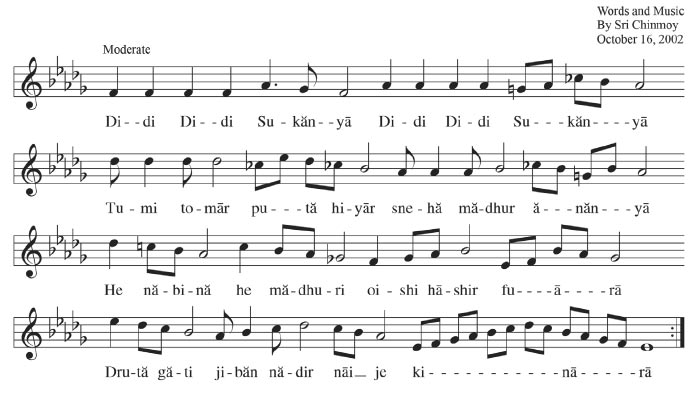
Didi Didi Sukanya Didi Didi Sukanya
Tumi tomar puta hiyar sneha madhur ananya
He nabina he madhuri oishi hashir fuara
Druta gati jiban nadir nai je kinara
Chinmoy Beena
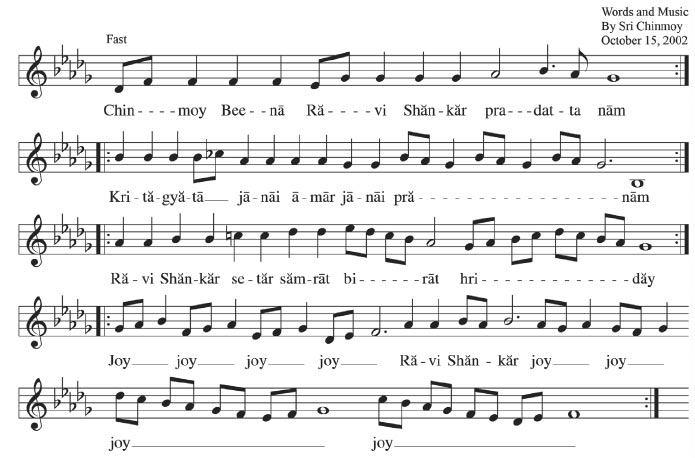
Chinmoy beena Ravi Shankar pradatta nam
Kritagyata janai amar janai pranam
Ravi Shankar setar samrat birat hriday
Joy joy joy joy Ravi Shankar joy joy joy joy
A Celebration with Ananda and Darshanika Guruge
On 29 July 2002 Sri Chinmoy welcomed Dr. Ananda Guruge and his wife, Darshanika, with members of their family to Aspiration-Ground meditation garden, to celebrate Darshanika’s birthday. Excerpts from the evening follow. 11Sri Chinmoy, after Darshanika’s niece, Anjali, played the sitar and sang: I am 71 years old, and for the first time I am hearing somebody sing while playing the sitar. At the Ashram, I have heard someone sing while playing the esraj. From Shantiniketan an excellent musician, Shanti Ghose, came. He set to music also Tagore’s songs. He sang as he played on the esraj. But for the first time in my life, I am hearing somebody accompanying herself on the sitar while singing. I am very, very proud of you.
Remarks by Dr. Ananda Guruge: Your Holiness Sri Chinmoy, we come all the way from the West Coast once a year because when Darshanika celebrates her birthday, we find that the blessings that you confer on us, the whole family, bring us enormous joy right through the year. Right through the year, this evening remains fresh in our memory because we have been blessed by some of the dearest people that we have come to know, thanks to your guidance and assistance. Every one of your disciples has taken us as family. And Darshanika, even more than I, belongs to the family in every way. That’s why, even on the eve of her going to Sri Lanka for a family wedding, she did not want to break the tradition. So we are having the birthday a day in advance because tomorrow she goes back to catch a fight to Sri Lanka, where she will be for the next three weeks.
But in trying to do it, we had a double event today because the evening, as you remember, started with that most enchanting music of Anjali. And Anjali was playing not only for Darshanika, but for her own grandmother, whose real birthday is today. So you have been blessing Anjali’s grandmother the same way as you have been blessing Darshanika and our family.
Everything in life is a case of loss and compensation. We had planned to be in Chicago with you next week, listening to your beautiful music, the prayerful music concert that you are going to have there. In fact, as Chicago happened to be an intellectual base of mine for quite some time, and I have many friends there, I made it a point to address a little note to all those friends to say, “This is an opportunity that you should never miss. An evening of prayerful music by Sri Chinmoy is a memorable occasion.” And I told them that I have known you since 1989. I have been a friend, I have been a brother. So has Darshanika been a friend and a sister, and our friendship, our fraternal affection, has increased year by year.
This is the reason why we come to you, and we are very happy that once again you made it a great event for us. We know how busy you are. To the Chicago people I gave a list, a statistical table, starting from 1,500 books and so many songs. And I said 11 million sketches of birds, but I’m sure you might have even exceeded that, because I find that every time I write anything about your achievements, even before the ink is dry, that number is out of date. And that is the great mind that you bring to our attention, that you display for our guidance as a true karma yogi, a yogi in action, a yogi whose every moment of life is a prayer, whose every moment of life is a meditation.
Darshanika: Sri Chinmoy-ji, my dear friends and my dear family, I enjoyed so much the beautiful singing of my sisters and brothers, of such wonderful devotional songs.
Guru-ji, thank you so much for helping me to celebrate my birthday with you and your spiritual family. My thousand pranams to you.
11. Dr. Ananda Guruge was Ambassador of Sri Lanka to France, UNESCO and the United States (1985-1994); former Senior Special Adviser to the Director-General of UNESCO; and Dean of Academic Studies and Director of the International Academy of Buddhism, Hsi Lai University.↩
Sneha Nirjhar – Affection-Fountain
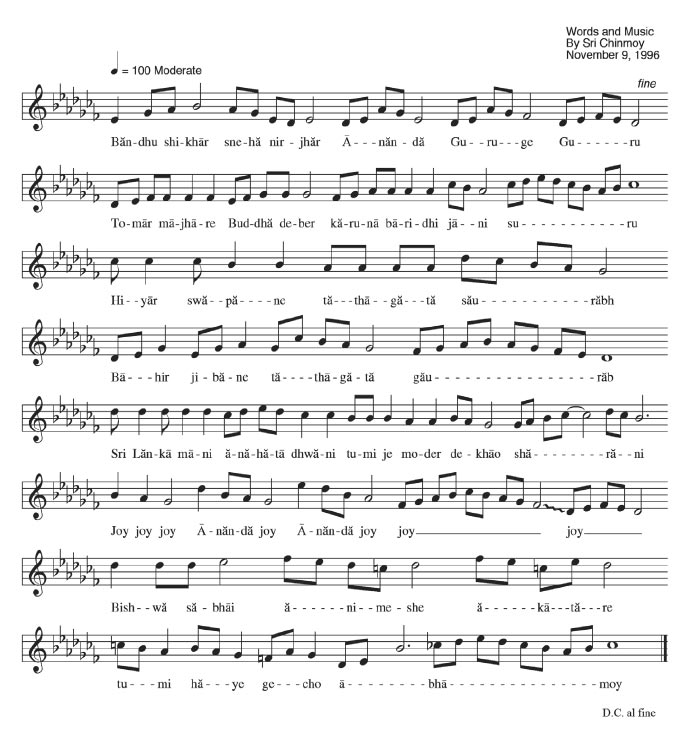
Bandhur shikar sneha nirjhar Ananda Guruge Guru
Tomar majhar Buddha deber karuna baridhi jani suru
Hiyar swapane tathagata saurabh
Bahir jibane tathagata gaurab
Sri Lanka mani anahata dhwani
Tumi je moder dekhao sharani
Joy joy joy Ananda joy Ananda joy joy joy
Bishwa sabhai animeshe akatare tumi haye gecho abhamoy
Darshanika... Tomar Bukkhe
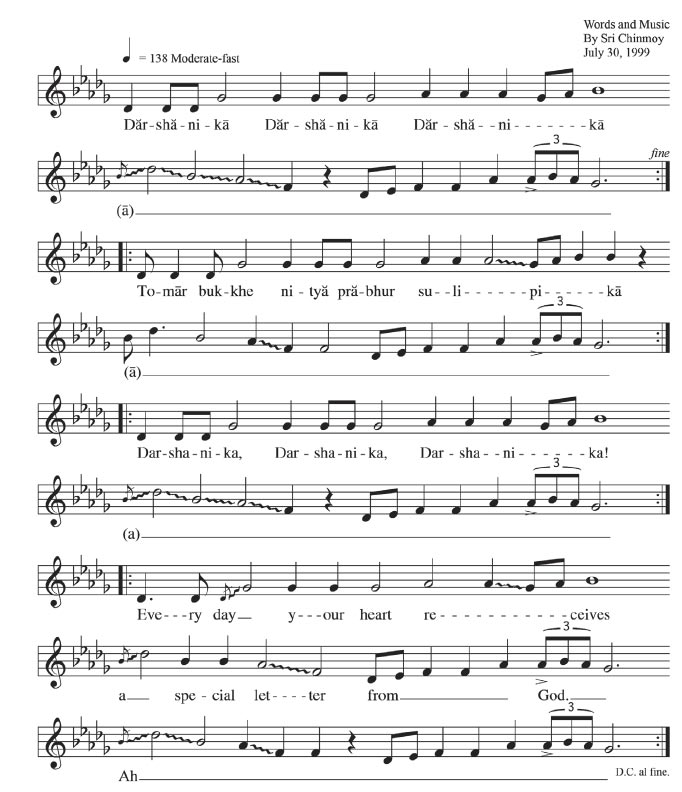
Darshanika Darshanika Darshanika
Tomar bukkhe nitya prabhur sulipika
Darshanika, Darshanika, Darshanika Every day your heart receives a special letter from God.
Darshanika... Animesher Heri Taba
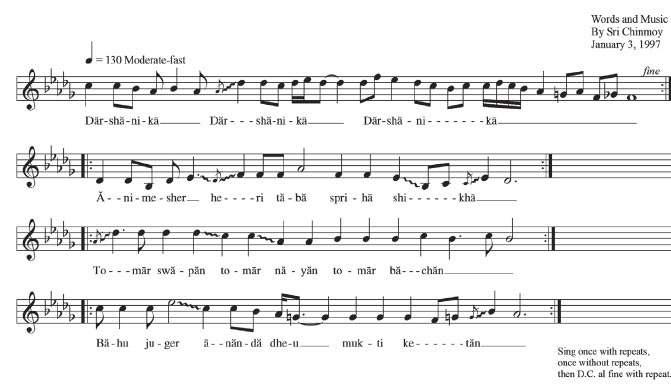
Darshanika Darshanika Darshanika
Animesher heri taba spriha shikha
Tomar swapan tomar nayan tomar bachan
Bahu juger ananda dheu mukti ketan
Meeting with Chandra Mohan
On 14 June 2002, Sri Chinmoy met with Mr. Chandra Mohan, the General Secretary of the International Comparative Literature Association at Annam Brahma Restaurant. A few excerpts from their conversation follow.Chandra Mohan: Meeting with you four years ago was a turning point in my life. I always talk to people about you, about our meeting. It is an obvious source of happiness and inspiration to think of you.
Sri Chinmoy: I feel the same about you! When I am with you, I get tremendous joy and inspiration. You have the divine qualities that we need both in our mind and our heart.
The mind itself is not bad, but we are sometimes using it in the wrong way – to suspect others, to doubt others and to find fault with others. The mind is an instrument, and we are the ones who use this particular instrument. Unfortunately, often we are unable to control the mind. The mind is controlling us. It is such a sad experience we are having. The mind can bring us the message of vastness, the message of universality, but it is not always doing this. It is not fulfilling its purpose, whereas the heart – no matter how small or how weak it is – is taking the side of God, of the Divine, of Right. It wants to establish its union and oneness with the rest of the world.
Very few people on earth have the illumined mind and at the same time the vast heart. Unfortunately, most human beings are taking one side. Most of them are taking the side of the mind.
Here science comes into the picture. Instead of building, we are demolishing everything in life. We see the destructive forces are now challenging the world, but not the forces of love. In every field, in every walk of life, we are seeing the poor heart is unable to come to the fore. The mind lords it over us in every field of life. The mind as such is not bad, but we are using it for a wrong purpose.
In your case, you have such an illumined mind and, at the same time, such a universal heart, so the divine qualities that you have are unparalleled. This is not flattery. Being a man of prayers and being an instrument of the Source, what I feel and what I see in you, I am telling you personally. These are the divine qualities that you have. They have to be manifested, and you are manifesting them according to your capacity.
But then again, when we increase our receptivity, our capacity increases like anything. Let us say you have abundant capacities to manifest God’s Light, no matter in which field you are now. But manifestation-capacity increases on the strength of our receptivity. The more we can open to the Light, the more we can receive and manifest. This is the role of spirituality. Spirituality does not negate the world. Real spirituality is not found only inside the Himalayan caves. Real spirituality, Swami Vivekananda said, is to serve mankind and to see the Divinity in each human being and in each sphere of life.
We are trying here, and I am trying with my students all over the world, to serve the Divine, to serve the Supreme in each human being. You are doing exactly the same. But to increase our capacity we must turn to spirituality. We are good, very good, but we can be excellent. Our goal is self-transcendence. Whatever you have achieved is not to be ignored. At the same time, we feel that we sing the Message of the Beyond. The ever-transcending Beyond is our motto. This is the message that I would like to offer to you – not to stop at a particular point. I should not say, “Oh, I am old. I have been to so many places.” Instead, I should ask, “Have I completely fulfilled the mission that I have been given by the Absolute Lord Supreme?” Then the answer comes, “Still there is a long way I have to cover.”
Chandra Mohan: I fully agree with you. Perhaps that is the signal which I should get, that I have come to this place, and you have very specifically arranged a meeting with me. Perhaps it is a signal from Above through you that I am getting.
I remember my father, who translated Aurobindo when he was ailing. He said, “Chandra Mohan, come. I will speak and you will write because I want not to die. I want to increase my longevity at least for three years so that you qualify for matriculation, and get a job. After I am gone, there is nobody to take care of the necessities.”
Then I knew Urdu, so he translated The Synthesis of Yoga. He spoke and I wrote, and we published it in this magazine Aum. Then he said, “Look, everything is fine. You will be praised. But this is not the goal. You may say, I achieved this, I achieved that, and my son has become this and my daughter has become that, and my family is fine. But ultimately you have to become one with the Lord, and that is not easy unless you put yourself into this completely.”
Then I said, “Okay, first thing is my livelihood. Of course, God will help me in my journey.” But now when you specifically tell me, then I think the time has come for me to put myself completely into this orbit.
Sri Chinmoy: Forgive me to say, your mind will say that you have accomplished 70 or 80 percent of what you were aiming at. But I would like to say it is not at all true in your case because you have consciously turned to spirituality. Spirituality always leads us to the ever-transcending Beyond. Your present capacity I know. But what you have offered to the world at large cannot be your true capacity. I can clearly see this because I am a man of prayers. You have not offered all of your inner capacities, because your heart-door is open, but it is not fully open so that anybody can come. It is open in a strict way so that only good people can come and bad people cannot come. When Swami Vivekananda opened his heart-door, he said, “If I claim good people to be my own, I must claim bad people also to be my own.”
Here, if you can keep your heart-door absolutely, totally open, twenty-four hours a day if you can sleeplessly keep it open, then you will see. You may be in Toronto, in Canada, but your life will be able to manifest in South Africa or somewhere else. When you have one good thought, that good thought will not be confined because that new, good thought has come from its Source, from its spiritual beginning. Then it is going to cover the length and breadth of the world.
That is what the spiritual Masters and the highly advanced souls have done for mankind. Swami Vivekananda used to say that if you are on top of the Himalayas and you have one good thought, it will immediately cover the four corners of the globe. We can do many things, but we should feel that we are the instruments, we are not the doers. There is a Source, and we are just representing the Source. According to our very, very, very limited capacities, we are manifesting the Source.
Chandra Mohan: Very true! Sri Aurobindo knew the divine Order, and through you is coming the divine Order. It comes to my surrendering the rest of my life.
Sri Chinmoy: You have read the Bhagavad Gita. You are an expert. There Sri Krishna spoke of devotion and surrender. Love we have for humanity. We devote ourselves, and we are devoted to the cause of humanity. But surrender to the Will of the Supreme is different. We use the term unconditional surrender. There are three rungs of a ladder. Two rungs you have climbed. You have loved mankind. You have devoted yourself completely, sleeplessly and breathlessly to the betterment of the world.
Then comes surrendering to the Will of God unconditionally. That we have to accomplish. That is the last page. Happily, self-givingly, sleeplessly and breathlessly we have to offer ourselves. There is no other way to accomplish that. It is from our renewed prayers and meditation. The main prayer Jesus Christ taught us is “Let Thy Will be done.” That is our motto, everybody’s motto, whether we are Indians or Americans. Everybody has to have this prayer.
Again, the Gita has taught us that we have no right to the fruits of our actions. (Quotes in Sanskrit) Karmany-evadhikaras te ma phaleshu kadachana. “Thou hast the right to action, but claim not the fruits thereof.” 12
Our difficulty is, as soon as we human beings do something, we pray for the results, and the results have to be to our satisfaction. But we never say, “God for God’s sake.” The moment we can say God for God’s sake, we accomplish everything. At that time we are not the doers. We are the actors.
But I am not giving you advice. I am just telling you what you truly are. What you truly are, you have not yet manifested. Some people feel that they have done everything that they are supposed to do. But they are wrong. Until our last breath, we cannot say that we have accomplished everything that we are supposed to accomplish. When we offer our last breath to Mother Earth, if the last breath is founded upon gratitude, then immediately we serve Mother Earth in a very unprecedented way.
Chandra Mohan: I think this is very rightly said, and I take a vow to follow it because it is said at the right time. In a year’s time I will complete my teaching tenure. Then I will be devoting more time to spirituality, although I will still be involved with these Associations.
Sri Chinmoy: Again, my brother, you are making a mistake when you think of the future as such, saying, “When I finish all my activities, my teaching tenure and all that, in the near future or the distant future, I shall devote all of my time to Divinity.” That future never comes. Our philosophy is here and now, in the immediacy of today, through each action. Right now you are teaching at the university, but you must feel what you are doing is ordained by God. This is the secret. You can start right from today, from this very moment.
Here two spiritual brothers are talking, and they have opened up their hearts completely. We are complementing each other. I am bringing to the fore what I have, and you are bringing to the fore what you have within. It is not that you will wait four years or five years until you are through with your outer experiences. We cannot separate the outer activities from our inner experiences. They go together. Only we have to feel what we are doing outwardly is coming from the inner inspiration, from the inner aspiration, from the inner dedication.
If somebody is pushing us forward, we have to go forward. But I have to feel that I am not going forward on my own. Something else – my divinity – is pushing me forward towards the Light, infinite Light. Your future is here, right at this moment – in the immediacy of today. Only change your outlook, that what you are doing at every moment is an expression and a revelation of your inner divinity. Each action is an expression of our own divinity.
Chandra Mohan: Yes, I fully understand. Consciousness comes from within. My prayer and meditation should be regulated more to become a part of my daily routine. Then the whole attitude towards daily happenings could be linked with my divine inspiration.
Sri Chinmoy: When we separate action from meditation, we are committing a Himalayan blunder. Action and meditation go together. Right now I am talking to you. We feel that this is action, this is not meditation. No, this is meditation, because meditation means oneness, oneness with the entire humanity. You and I are two individuals. While we are acting, we are feeling our oneness. How sincerely, how self-givingly we are talking to each other! What else is meditation if not oneness? Meditation is oneness founded upon vastness. The finite in us is meeting with the Infinite. Together we are talking about spirituality and Divinity, which is the Infinite.
But again, we are using our human language. We are seeing each other as physical entities. Here the finite and the Infinite are going together. Your finite existence and your Infinity, and my finite existence and my Infinity, are going together. Action and meditation must go together. Otherwise, we separate them the way we are separating the mind from the heart, the heart from the mind. They have to be together. At every moment you have to feel whatever you do is an inspiration in the process of revelation and manifestation.
You are a professor. I am saying you have not given to Mother Earth fully. Some professors, after 20 years or 30 years, feel, “Oh, I have given even more than I thought I possibly could.” But that is the wrong attitude. Nobody can say this because at every moment we are inundated with new possibilities. Ever-new possibilities we have to manifest through our speech, through our actions, through our self-giving and in our entire being.
Traditional scripture, as quoted by Sri Chinmoy in The Oneness of the Eastern Heart and the Western Mind, Part 1. New York: Agni Press, 2003.↩
Chandra Mohan
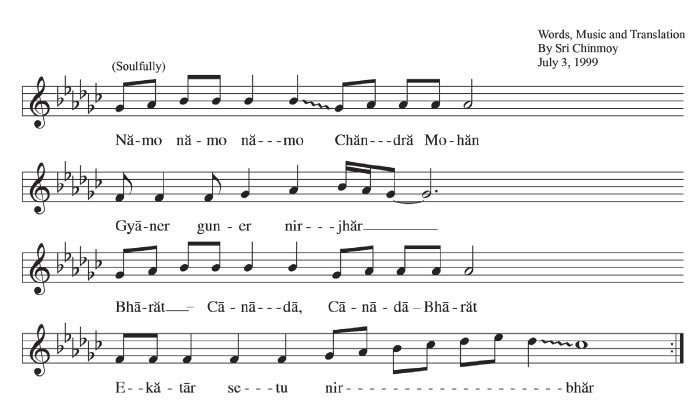
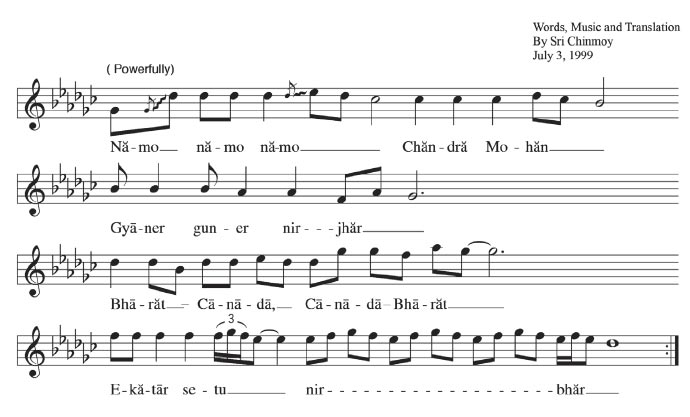
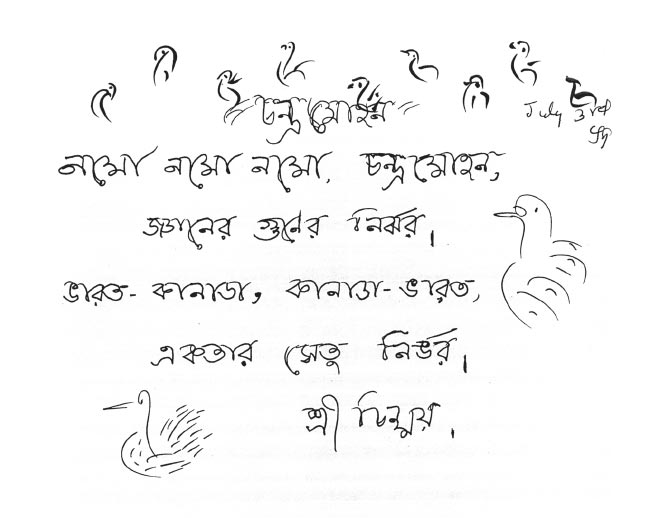
Namo namo namo Chandra Mohan
Gyaner guner nirjhar
Bharat-Canda, Canada-Bharat
Ekatar setu nirbhar
I bow and bow and bow,
To you, Chandra Mohan:
A fountain of wisdom-light
And virtue-delight you are.
India-Canada, Canada-India,
You are their oneness-interdependence-bridge.
A Private Concert - Offered by Pandit Jasraj
On 18 September 2002, the legendary Indian vocalist Pandit Jasraj offered a private concert at Aspiration-Ground meditation garden, accompanied by Ustad Kadar Khan on tablas and Pandit Jasraj’s student Ms. Tripti Mukherjee on harmonium. Before the concert, Sri Chinmoy honoured Pandit Jasraj with the “Lifting Up the World with a Oneness-Heart” Award, and also lifted Ustad Kadar Khan. Following are excerpts from the occasion.Excerpts from the introduction by Mallikarjun Rakala: Pandit Jasraj says when he sings, sometimes he feels he is on the verge of samadhi. He will always sing for God. His music is his aradhana or worship of God. His first teacher was his own father, Pandit Motiram-ji, and his second teacher was his older brother, Maniram-ji. His career began at the age of 22, when he performed for King Vikram of Nepal. He has been performing for 50 years and has received innumerable titles and awards, including the Padma Shri and Padma Busha from India. 13
Sri Chinmoy, after the concert: Because you sang and we listened, you have transported us into Heaven. Before you sang, we were on earth. Now we are in Heaven because you have transported us into the realm of the highest Heaven. This is what you can do for the aspiring humankind. My heart will cherish and treasure this moment sleeplessly and breathlessly. You have blessed our Aspiration-Ground. This particular Aspiration-Ground today you have raised to the highest realm of Heaven. Therefore, our gratitude to you will be ever-blossoming.
Pandit Omkarnath (Thakur) came to the Sri Aurobindo Ashram, and he sang. His voice is thunder-like, so powerful. But your voice is not only powerful, but also sweet. The power aspect Pandit Omkarnath showed us. How loudly he could cover four or five blocks! But forgive me to say, the sweetness, the inimitable sweetness, immeasurable sweetness that you have, we could not find in his voice. The power aspect he showed, tremendous power. But along with power, you have shown us sweetness, tenderness, softness and all the qualities of light and delight. Light and delight embody all the divine qualities. You embody those divine qualities.
India’s third and fourth highest awards for civilians.↩
The Sweetness of Pandit Jasraj’s Voice
How sweet Pandit Jasraj’s voice is! Once it was a very hot day and he was singing something about Meghabali, the hero of our clouds. And while he was singing that particular melody, all of a sudden there were clouds in the sky and then rain descended profusely. Another time he was singing and the whole audience was transported to Heaven. Out of the blue a deer came and stood in front of him. Like that, he has had many, many experiences.Pandit Jasraj has been to the Sri Aurobindo Ashram four or five times, he said. He is very, very religious, to the core.
Pandit Omkarnath Thakur’s Kindness for Pandit Jasraj
There is an incident with Omkarnath and Jasraj. When Jasraj was only 12 or 13 years old, there was a musical conference. There people were singing. Then when Jasraj came, because he was a young boy, everybody started going away, thinking what would this silly young fellow sing? Omkarnath was so well-known. He said, “Stop, stop, stay here. We have to hear the little boy.” And the little boy sang so well. Then Omkarnath asked him whose son he was, so he told him. Omkarnath said, “Oh, you are the son of a lion,” since his father was also a great singer.
Dilip Roy, the Golden Voice, and Omkarnath
Dilip Roy was known as the golden voice. Everybody appreciated, admired and adored his voice – sweeter than the sweetest, unimaginable! Once there was a classical music conference. They invited also lyrical singers of lyric songs, like mine. Dilip Roy was like an emperor in that field.But these are two different fields, like history and geography – two different subjects. Unfortunately, some classical singers find it difficult to appreciate the melodious songs, Tagore’s songs and others. But again, vice versa – some lyrical singers cannot appreciate how the classical singers improvise with their voices. There is always controversy between lyrical songs and classical songs.
On this occasion, when Dilip Roy came on the stage, the great singer Pandit Omkarnath stood up and said, “Is he a musician? Is he a singer? How can he be on the same footing as classical singers?” Everybody was stunned. What an insult! He was a singer in his own right, in a different field, lyrical. He had a sweeter than the sweetest voice. Omkarnath’s voice was so powerful. He could cover six blocks. But his voice was no match for Dilip Roy’s voice in sweetness and tenderness – so haunting. So Dilip Roy was very badly insulted.
Many years later Omkarnath wanted to come to the Sri Aurobindo Ashram and sing for Sri Aurobindo. Dilip was Sri Aurobindo’s darling, dearer than the dearest. Sri Aurobindo said Dilip was Sri Aurobindo’s son in a previous incarnation. When Dilip Roy heard about Omkarnath, he was furious. How could Omkarnath sing for Sri Aurobindo? Omkarnath came from Gujarat, and there were quite a few eminent Gujarati disciples of Sri Aurobindo. They begged Sri Aurobindo to listen to Omkarnath’s voice.
Now Sri Aurobindo was in a dilemma. One was his dearest son, and the others were his eminent disciples. Sri Aurobindo said, “All right, this is what I can do. He cannot sing in front of me, but he will be singing across the street. Across the street there is an Ashramite’s house. There he will sing.”
Omkarnath’s voice Sri Aurobindo could easily hear. Omkarnath’s voice could cover six blocks, it was so powerful, and Sri Aurobindo’s room was very close. Only a small street separated Sri Aurobindo’s room from that house, which was my dearest mother Mridu’s14 place. Omkarnath did not sing inside the house. He sat outside, on the pavement. He was singing as loudly as possible. It was his natural voice.
Dilip Roy lived two and a half blocks from Mridu’s house, on the same block as our house. Our house was on one end, and his was on the other end, only a matter of 70 metres apart. Now what did Dilip Roy do? He hired a rickshaw. When Omkarnath started singing, he took a rickshaw and disappeared, and came back after two hours or so because he did not want to hear Omkarnath’s voice.
This story is one hundred percent true. I was there at that time in the Ashram. So you can see how much rivalry classical and lyrical singers can enjoy. Dilip Roy was insulted on the stage, and then Sri Aurobindo did not want Omkarnath to sing in front of him.
18 September 2002 Aspiration-Ground, New York
Mridu was one of several older ladies at the Ashram who showered motherly concern on Sri Chinmoy.↩
Function Honouring Arlo Guthrie
On 13 July 2002 at Aspiration-Ground meditation garden, Sri Chinmoy honoured American folk musician Arlo Guthrie and his legendary musician-father, Woody Guthrie, who left this world in 1967. Woody Guthrie’s songs celebrated the poor, the unemployed and the homeless of the Great Depression. Arlo Guthrie’s most famous song, “Alice’s Restaurant”, became one of the great anti-war anthems of its time (1968).Sri Chinmoy read out the English translation of his Bengali song in honour of Woody Guthrie:
Woody Guthrie, Woody Guthrie, Woody Guthrie!
You are the soulful seeker of Infinity’s New Dawn
And Eternity’s New Day.
A flood of excruciation-tear-pangs within,
Self-giving and self-effacing pilgrim-mendicant without.
Aspiration-beauty loved you as its very own.
Tenebrous realities of human separation-lives
Your heart sleeplessly pined to illumine and unify.
After performing the Bengali song for Woody Guthrie, the singers performed Sri Chinmoy’s English song dedicated to Arlo Guthrie, with the following lyrics:
Fire within, softness without;
Within silence, without sound.
Father’s Dream-Boat-sailor,
Father’s footsteps-trailer.
A climbing heart-crier,
A smiling life-diver.
Your victory-road is clear.
Nowhere, nowhere self-doubt, fear.
Simplicity’s vast freedom-light
Embraces your soul’s Himalayan height.
The singers then sang two songs in which Sri Chinmoy set Arlo Guthrie’s words to music, and ended with Woody Guthrie’s famous song “This Land Is Your Land” and Sri Chinmoy’s version to the same tune, “This Heart Is Your Heart.” 16
Sri Chinmoy honoured Arlo Guthrie and his wife, Jackie, with the “Lifting Up the World with a Oneness-Heart” Award. Sri Chinmoy also lifted their son, Abe, and two associates.
Arlo Guthrie: Thank you so much for today. I grew up not too far from here, and as I was on my way I thought, “How does somebody like me, who was a little kid here years ago, grow up to meet somebody who is as internationally known and loved as you?” It is just a wonderful pleasure to be here today, so close to where I was a child.
Here is a song I wrote one night during Shivaratri. We were sitting around by the dhuni fire. My Guru was talking, and she looked around and said, “Wake up, wake up, everybody!” She said, “Wake up dead!” I wrote a song with those words. 17
Arlo Guthrie sang his song “Wake Up Dead,” to enthusiastic applause from the gathering.
Sri Chinmoy: We are all sleeping! We have to wake up.
Arlo Guthrie was asked about his famous song, “Alice’s Restaurant.”
Arlo Guthrie: Thank you, thank you! Namaste. I do not know about it being the greatest anti-war song. It is probably the longest anti-war song. What inspired me? I was not actually inspired. I think it just happened to me, and all I did was write it down. I am not one of those artists who think a great thought and then craft it into a song. Things just happen to me, and I just write them. All of the things in “Alice’s Restaurant” were true. I did not have to make up anything. I hope that is an answer.
Sri Chinmoy: It is an excellent answer! Everything comes from within, spontaneously. Inspiration does not need any outer help. It comes spontaneously, directly from your soul. When it comes from within, directly from the soul, you do not need any outer help. It comes to the fore, and you just become an instrument. You do not wait for the inspiration-bird to come to you. Spontaneously inspiration comes from within, and you become the instrument of God.
Arlo Guthrie: Is that how you write your songs?
Sri Chinmoy: Everything comes from within. Inside we have the ocean, we are the ocean itself; outside we are tiny drops. But we are trying to bring to the fore the ocean of love, the ocean of peace, the ocean of harmony. This is what our aim is. All those who are seeking the highest truth and light are trying to bring forward from deep within what they have to offer to the world at large. This is what you have been doing all your life. This is what your father did.
13 July 2002, Aspiration-Ground, New York
16. Published in Sri Chinmoy’s book of the same name containing folk song melodies, some with Bengali words. Agni Press: New York, 1993.↩
17. Arlo’s devotion to a Hindu-based path is reflected in the words, which include: “The death of what’s dead is the birth of what’s living... It’s the life that lies sleeping when you think you’re awake, Forever is real and the rest is just fake.”↩
Arlo
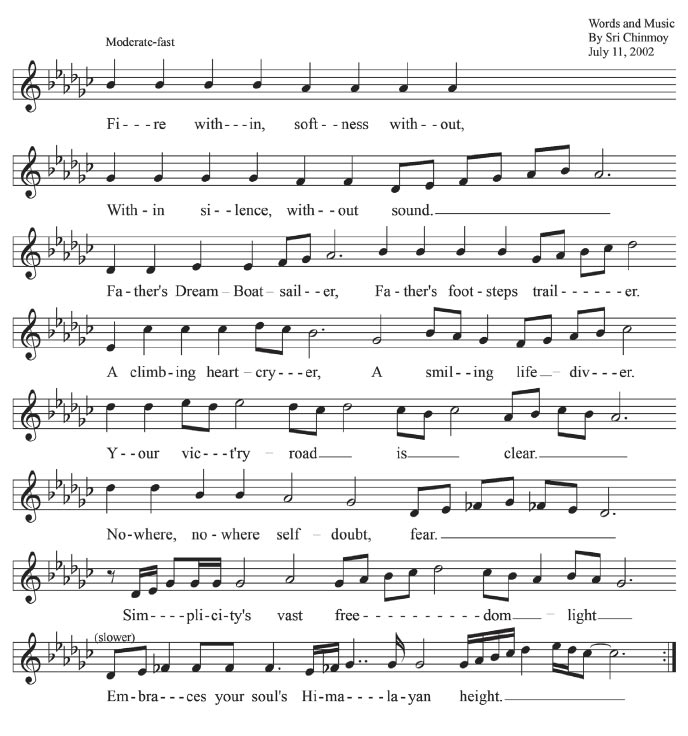
Fire within, softness without;
Within silence, without sound.
Father’s Dream-Boat-sailor,
Father’s footsteps-trailer.
A climbing heart-crier,
A smiling life-diver.
Your victory-road is clear.
Nowhere, nowhere self-doubt, fear.
Simplicity’s vast freedom-light
Embraces your soul’s Himalayan height.
The Death of What’s Dead
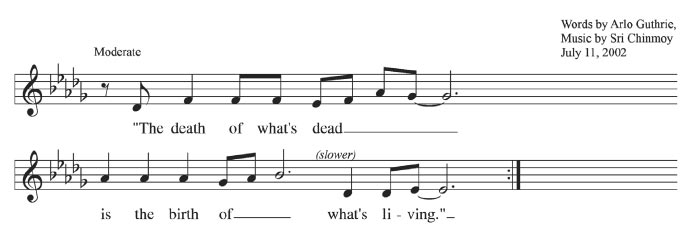
“The death of what’s dead is the birth of what’s living.”
- Arlo Guthrie
If You Are on the Last Train
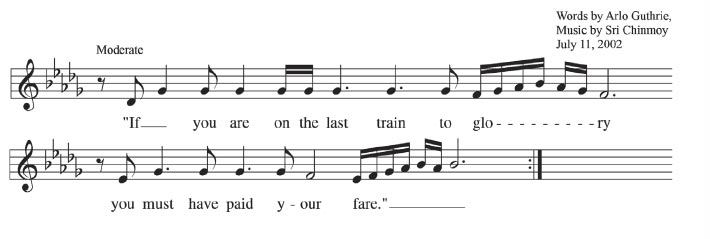
“If you are on the last train to glory
You must have paid your fare.”
- Arlo Guthrie
This Heart Is Your Heart
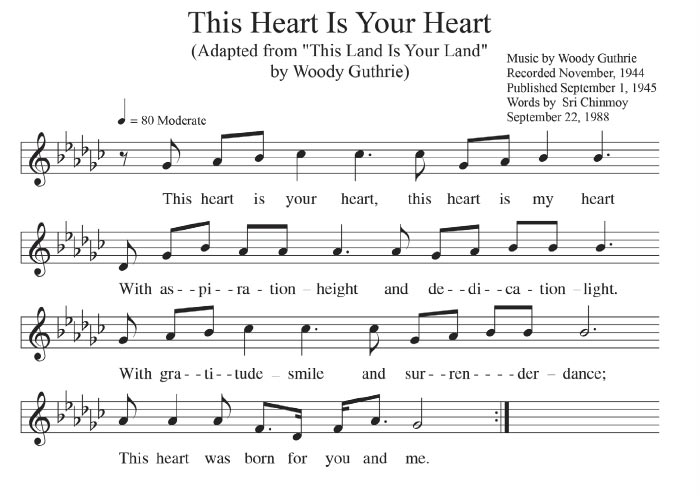
(Adapted from “This Land Is Your Land” by Woody Guthrie)
This heart is your heart, this heart is my heart
With aspiration-height and dedication-light.
With gratitude-smile and surrender-dance;
This heart was born for you and me.
The Darling of the Mother Divine: Sukhukee Ida Patterson
Sri Chinmoy had the following exchange with Sukhukee Ida Patterson, at a function on 4 August 2002 at the Palmer House Hilton in Chicago. The previous day he had offered her the name Sukhukee on the occasion of her 86th birthday. On 4 August he composed a Bengali song in her honour, with an English translation.I am so grateful to our Minneapolis disciples that they were able to bring my sister here, and she has given us boundless joy. Yesterday I gave her the name Sukhukee, meaning “The very darling of the Mother Divine.” Now let me honour my dearest sister.
Sri Chinmoy composed a song in Bengali and taught it to the singers, with the following translation:
The very darling of the Mother Divine,
You inundate everybody with happiness.
You at once embody the sister’s pure love
and the mother’s sweet affection.
You claim everyone to be your own, very own.
No stranger have you.
Somebody in New York will type the song nicely, and then we will mail it to you. In a few days’ time you will get the song. And your Centre, the Minneapolis Centre, is blessed with very good singers. They will learn it, and then make a recording for you.
18. Sri Chinmoy first met Ida Patterson when she was visiting the Sri Aurobindo Ashram in Pondicherry in 1962, and she subsequently offered him support after he came to America.↩
Sukhukee
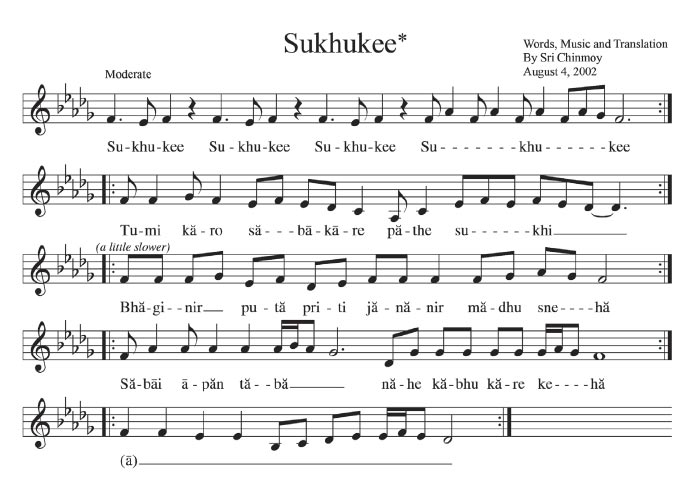
Sukhukee Sukhukee Sukhukee
Tumi karo sabakare pathe sukhi
Bhaginir puta priti jananir madhu Sneha
Sabai apan tabe nahe kabhu kare keha
Sukhukee - Spiritual name Sri Chinmoy gave to Ida Patterson
My Sister, Ida Patterson, Eternity's Flower-Dawn
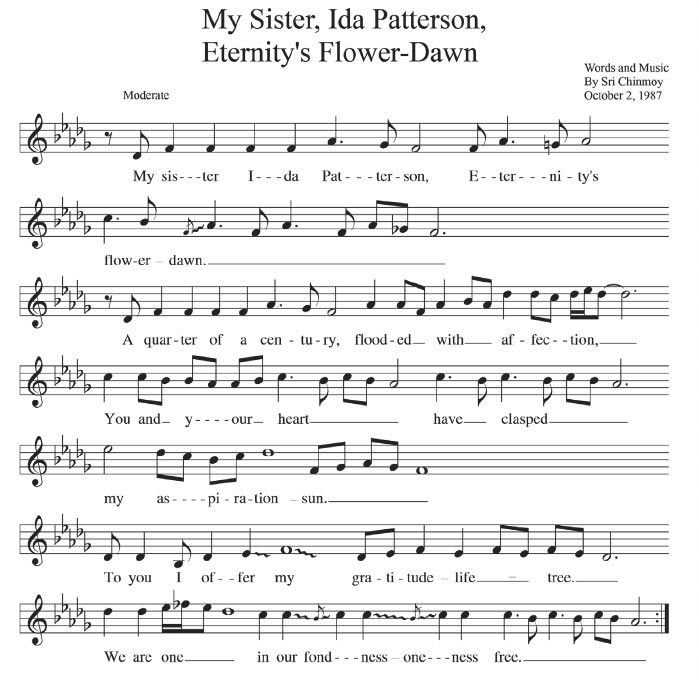
My Sister, Ida Patterson,
Eternity's flower-dawn.
A quarter of a century, flooded with affection,
You and your heart have clasped my aspiration-sun.
To you I offer my gratitude-life-tree.
We are one in our fondness-oneness free.
Tales From India
Tagore and C.R. Das
Chitta Ranjan Das was earning so much money, but he gave up his law practice to defend Sri Aurobindo. When Sri Aurobindo was in jail, Sri Krishna came to Sri Aurobindo and said, “Give all responsibility to C.R. Das. You will not give your advice. He is the one I have chosen to release you from jail.”C.R. Das gave up everything. Day in and day out he worked so hard, dedicating his life to Sri Aurobindo. He gave a momentous speech about Sri Aurobindo on the day of his release from jail and said that his voice would echo and re-echo. Such a powerful message he gave!
Then C.R. Das went into politics. He came to see Sri Aurobindo. They had been such good friends. Sri Aurobindo said, “Politics and spirituality do not go together. Give up politics if you want to realise God.”
C.R. Das could not give up politics. This is human life! Sri Aurobindo was like the ocean in terms of God-realisation, but C.R. Das went to another spiritual Master who was perhaps like a few drops of the ocean. That spiritual Master was absolutely nothing in comparison to Sri Aurobindo’s spirituality, intellect and vastness of mind.
C.R. Das was also a poet, but Tagore was infinitely, infinitely better than C.R. Das as a poet. Again, C.R. Das was such a great figure. Millions of people gathered together for his funeral and cremation.
When C.R. Das passed away, his devotees went to Tagore and begged him, “Please say something. Now he has passed away, and we are swimming in the sea of grief.”
Tagore dived deep within and wrote two immortal lines in Bengali. The meaning is:
With thee came down the immortal breath. This thou booned us with thy body’s death.
C.R. Das’ devotees quoted Tagore’s words everywhere.
3 June 2002 Sri Chinmoy Centre
Bama Kshepa’s Sincerity
When the spiritual devotee Bama Kshepa19 got angry with his deity, the Divine Mother Tara, he used to shout and scream at her statue, and use such foul words. People used to say, “You are known as her dearest! Why are you behaving like this?” Sri Ramakrishna would sometimes get angry with his Divine Mother Kali, but his tongue was not foul. Bama Kshepa’s tongue was so foul, the book says people used to run away. He was the greatest devotee of Mother Tara, but what can you do? He was so sincere, whatever was on his mind, he used to express it.In our case, if we get angry with the Supreme, we are civilised. We do not say anything outwardly, even if we have lost faith in the Supreme or the Guru. Some people have lost faith, but as soon as they see their Guru, outwardly with folded hands they show all their faith.
16 September 2002 Sri Chinmoy Centre
19. Bama Kshepa was a contemporary of Sri Ramakrishna, famous both for his compassion and his devotion to the Goddess Tara, and for his eccentric behaviour.↩
Kazi Nazrul Islam: Eternally Grateful to This Mighty Soul
I have the deepest love and admiration for Kazi Nazrul Islam. He united Hindus and Muslims in the very depths of his oneness-heart. For that we shall eternally remain grateful to this mighty soul.Kazi Nazrul composed “Chal…Urdha Gagane Baje Madal,” absolutely one of the most famous songs in Bengal. Many, many schools sing that song. It is one of the national songs now. The main national song is Tagore’s “Amar Sonar Bangla,” but this one many high schools have adopted.
In my song for Kazi Nazrul Islam’s centenary20 I have used the words giti plaban, “the flood of songs.” He wrote many, many songs. I translated that song, and it came out in a newspaper.
Kazi Nazrul’s dearest friend lived in the Ashram. His name was Nolini Kanta Sarkar. Dilip also was a very close friend, but the dearest was Nolini Sarkar. Nolini Sarkar was very, very kind to him.
During the last four or five years of his life, Kazi Nazrul suffered greatly. He was completely paralysed. He was a Muslim by birth, but his wife was a Hindu. He wrote so many songs on Indian Gods and Goddesses. “He Partha Sarathi” (O Charioteer of Arjuna) is about Sri Krishna. He wrote songs about Mother Kali, Durga and all the Goddesses. His son had a Hindu name, Savyasachi. Savyasachi was also a good musician, although not like his father.
Kazi Nazrul was a poet also, and in poetry he stood next to Tagore. He said, “If people criticise my poetry, I do not mind. But if they criticise my songs, it deeply hurts me because they come from the very, very depths of my heart, from a very secret and sacred source.”
18 May 2002 Public School 86
20. Kazi Nazrul Islam. The song and translation appear at the end of this section.↩
Kazi Nazrul Islam
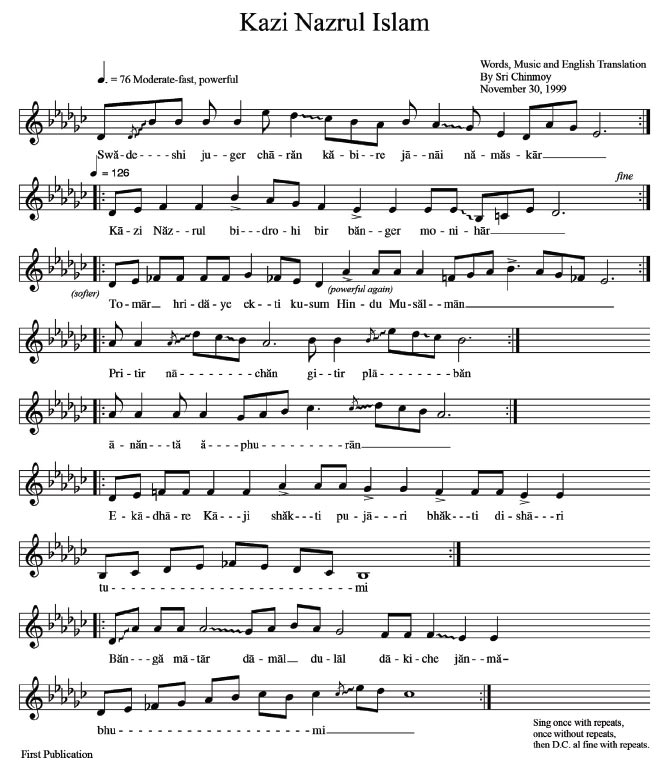
Swadeshi juger charan kabire
Janai namaskar
Kazi Nazrul bidrohi bi
Banger monihar
Tomar hridaye ekti kusum
Hindu Musalman
Pritir nachan gitir plaban
Ananta aphuran
Ekadhare Kaji shakti pujari
Bhakti dishari tumi
Banga matar damal dulal
Dakiche janmabhumi
Kazi Nazrul: Revolution-Hero - Mother Bengal’s Ever-Charming and Ever-Enlivening Darling
I bow to you, O inspiration-fountainPoet-singer-musician of India’s
Revolution-freedom-declaration-aspiration-days,
Kazi Nazrul,
The indomitable hero of Bengal’s precious
Heart-garland-jewel.
In your heart breathes one single flower
With beauty and redolence –
The Hindus and the Muslims.
You were at once the dance of love
And the flood of songs, endless and infinite.
In one earthly frame you were
The worshipper of Power supreme
And
The beckoning hands
Of heart-deepening devotion.
O Mother Bengal’s ever-charming
And ever-enlivening darling,
Far beyond the self-discipline-boundaries,
...Mother Bengal is calling you.
Do hearken to the ever-blossoming
Blessing-affection-fondness-
Gratitude-heart-pride-call
Of your Bengal Motherland
Chal
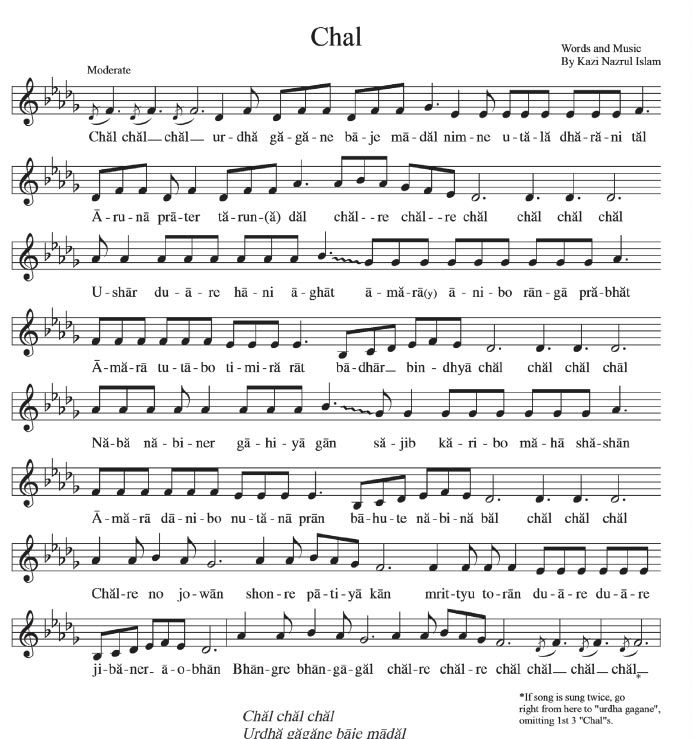
Chal chal chal
Urdha gagane baje madal
Nimne utala dharani tal
Aruna prater tarun dal
Chalre chalre chal
Chal chal chal
Ushar duare
Amara anibo ranga Prabhat
Amara tutabo timira rat
Badhar bindhya chal
Chal chal chal
Naba nabiner gahiya gan
Sajib karibo maha shashan
Amara danibo nutana pran
Bahute nabina bal
Chal chal chal
Chalre no jowan shonre patiya kan
Mrittyu toran duare duare jiban aobhan
Bhangra bhangagal chalre chalre chal
Chal chal chal
He Partha Sarathi
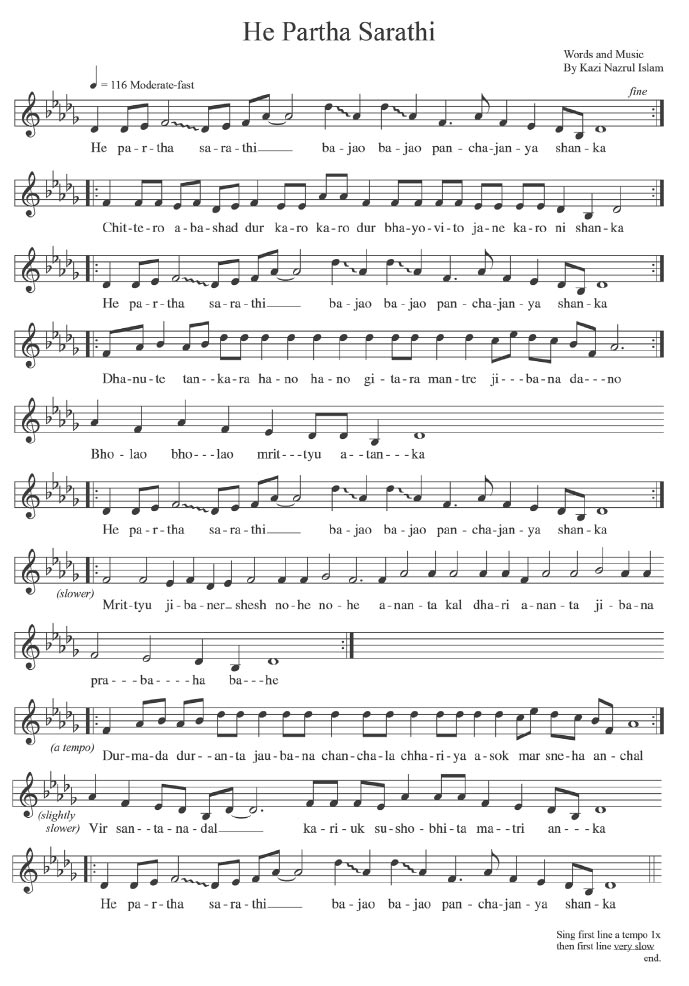
He partha sarathi bajao bajao panchajanya shanka
Chittero abashad du karo karo dur bhayovito jane karo ni shanka
Dhanute tankara hano hano gitara mantre jibana dano
Bholao bholao mrittyu atanka
Ananta kal dhari ananta jibana prabaha bahe
Durmada duranta jaubana Chanchala chhariya asok mar sneha Anchal
Vir santanadal kariuk sushobita matri anka
O Charioteer of Arjuna,
Blow, blow your conch, “Pancha Janya.”
Drive away this depression of the heart,
Make them fearless who are struck with fear.
O Charioteer of Arjuna,
Blow, blow your conch, “Pancha Janya.”
String the bow and hit the target.
Singing the mantra of the Gita,
Sacrifice your life;
Make us forget the fear of death.
O Charioteer of Arjuna,
Blow, blow your conch, “Pancha Janya.”
Death is not the end of life:
Through Eternity flows the eternal tide of life.
Let the dauntless and indomitable young men
Leave the affection-attachment lap of their human mothers
And take shelter in the Supernal Lap of the Universal Mother
And adorn it divine and supremely.
O Charioteer of Arjuna,
Blow, blow your conch, “Pancha Janya.”
Childhood Stories
This World Is So Small!
I come from a tiny village. It is called East Shakpura. “Shakpura” means “full of vegetables,” so my life is full of vegetables! But before I joined the spiritual life at the Sri Aurobindo Ashram, I ate meat three or four times a week, and fish every day. It is very common for Bengalis to eat fish every day.Today a Bengali gentleman came here to Aspiration-Ground. I lifted him and his wife. He lives six or seven miles away from here. His cousin studied at the same village high school where I studied, and he remembers me so well! We were class friends. His name is “Sudisen.” 21 He came from East Shakpura, only four or five blocks away from my house. For our matriculation we had to study up to tenth grade. I studied with him in grades three, four and five. I was at that time nine, ten and eleven. Ten, when it was time for the sixth grade, I went to the Sri Aurobindo Ashram.
“Sudisen” remembers me so well. Now his cousin lives here in Queens. Look at the connection, from when I was a little boy. This world is so small, so small!
25 May 2002 Aspiration-Ground, New York
21. “Sudisen” is an approximation of the name as it was recorded when Sri Chinmoy spoke.↩
My Cousin’s Wedding
Our distant cousins, from the same Ghosh22 family, lived two or three houses away from us in the village of Shakpura. The day before their son’s wedding, my father died. In Indian tradition, when somebody dies, when the soul goes to Heaven, the whole family is considered impure. That meant that our cousins, also, were impure. It is considered a very bad sign.The wedding was the following day. My cousin’s family wanted to keep it top secret that my father had passed away. They pretended nothing had happened, and the next day the bridegroom went to the bride’s place to bring her in the palanquin to the wedding.
But in the village, nothing remains a secret. The bride’s family came to learn somehow about my father’s passing, and they were furious. Both the bridegroom and bride were supposed to ride in the palanquin. But the actual bride did not come. In Indian villages, usually parents make the decision about their children’s marriage. Wives do not see their husbands beforehand, and vice versa. So the groom did not know what the bride looked like.
The bride’s brother was nice looking, and he put on a sari. What happened, instead of the bride, the brother was riding with the groom in the palanquin three and a half miles to the site of the wedding. Half a mile before they reached the destination, the so-called bride said she had to respond to nature’s call immediately. The palanquin bearers were shocked and embarrassed because she was a girl. The brother went behind a bush, and then he disappeared completely. The palanquin bearers and my cousin were waiting for the bride. She was nowhere to be found. So the groom went back home, without the bride.
After the traditional one month mourning period, the bride’s family still did not trust our cousins, so they did not allow their daughter to marry the groom. This story happened in our family, to our distant cousins.
16 September 2002 Sri Chinmoy Centre
22. “Ghosh” is a variation of “Ghose,” as used by some of Sri Chinmoy”s relatives.↩
Stories from the Ashram
Dilip Roy: Spiritual Child of the Mother and Sri Aurobindo
Once Dilip Roy was feeling disheartened about certain experiences at the Ashram. Then in the evening he went to the seashore, the Bay of Bengal. There a foreigner was meditating. The man came to Dilip Roy and said, “How long have you been here?”He said he had been there for 25 years.
“Please tell me something about the Mother and Sri Aurobindo,” the foreigner said.
On that day, Dilip was so discouraged, but he started saying such nice things about the Ashram and the Mother and Sri Aurobindo. So he wrote to Sri Aurobindo. He said, “I’m such a hypocrite. The whole day I was so disheartened. Then when this European came, I told him such nice things about you and the Ashram. What have I said? I am such a hypocrite.”
Sri Aurobindo said, “No, at that time your vital, your demanding vital, left. Your soul was able to come to the fore. When the soul comes to the fore, at that time we are so good. Your soul was able to come to the fore, and it pushed aside your demanding vital. So you did the right thing.”
Sri Aurobindo was so wise. Sri Aurobindo said, “That is the right thing.” It happens to many disciples. The day you are discouraged or suffering from self-doubt or doubting the Master or your spiritual life, on that day somebody comes and asks you about your spiritual life. In this way God brings your divinity forward, and you say such nice things. You are not a hypocrite. God wants your divinity to come to the fore. Again, the roguish mind will tell you, “Look, what a rogue you are. You are all criticism, and now you have become such a saint.”
16 September 2002 Sri Chinmoy Centre
23. In Sri Chinmoy’s book dedicated to Dilip Roy, entitled My Dilip-Da-Adoration (New York: Agni Press, 2007), he refers to “Dilip Kumar Roy, the Golden Voice,” as one of his “heroes,” and relates several stories illustrating Dilip’s kindness in encouraging the young Chinmoy in his poetic endeavours.↩
As noted earlier in this volume, Dilip Roy, the famous singer of Indian lyrical songs and Bengali devotional songs, lived in the Ashram from 1928 to 1953. Sri Aurobindo called Dilip his dearest son. Dilip was Sri Aurobindo’s darling, dearer than the dearest. Sri Aurobindo said Dilip was Sri Aurobindo’s son in a previous incarnation.↩
When Dilip Roy was visiting New York while traveling on tour in the mid-1960s, the Indian Consul General in New York assigned Sri Chinmoy to go and greet India’s famed Golden Voice at the airport and personally escort him back to the Consulate, where Sri Chinmoy was a trusted staff member at the time. The conversation in the limo on the way back to Manhattan was filled with fond reminiscences of the Ashram and inquiries by Dilip-da about Sri Chinmoy’s family members.↩
He Inspired Me to Run
I did the triple jump for so many years. The triple jump is so dangerous once you take the hop. Right in front of the Mother, one boy named Hriday jumped and sank down, and his kneecap was completely dislocated. They took him to the hospital.Hriday was three years my senior. I thought I would spend more time in meditation, but he inspired me also to run. He used to come to my place and teach me how to take the start – and, alas, I always defeated him during the competition. I was the fastest, and he stood fourth or fifth. Then what would he do? As soon as the race was over, he was so proud of me that he would come and embrace me. Right in front of the Mother and so many people, he embraced me because I stood first.
Hriday eventually got married and moved to Canada. A few days before the Montreal Olympics, I received a message from him. He said, “Now I am stuck in Montreal. I want to go back to India with my wife and child. Can you help me?”
I said, “Only on one condition I shall send you money: you must not tell anybody!” I sent him some money via a Canadian disciple.
Not even a week later, his aunt happened to see my sister Lily on the street in Pondicherry. She said, “Lily, look at your brother! He believes in friendship. He gave money so that Hriday and his wife and child could come back to India. Otherwise, they could not have come back.”
I had requested him not to tell anybody, but he informed his family, and his aunt told my sister that I have a good heart!
At the age of forty-six, Hriday died. His wife and child went back to the Ashram. His wife had such an excellent singing voice! Her voice was unimaginably haunting. Everybody in the Ashram was mesmerised by her voice.
When I went to the Ashram after Hriday passed away, his son, who was still a boy, was so tall – taller than me! I did not know who he was, since I had never seen him before. The Ashram custom is to use “da” for one’s elders. “Da” actually means “uncle,” but if you are the father’s friend, the child also calls you “da.” This boy called me Chinmoy-da. He was so tall, so bright! Then he told me his father’s name, Hriday.
I asked the boy, “Which line of work do you want to go into?”
He said, “I want to become a doctor.” I said, “I am so happy! Be a doctor.”
Later he went to England and other places to study. He is practising medicine in a hospital somewhere, perhaps. This is life.
4 February 2002, Sabah, Malaysia
Revising the Book
In my childhood, you could say that I was extremely mischievous! I do not think any of my brothers and sisters had been as mischievous as I was. Then, in the Ashram, I became a so-called saint. There I behaved very, very well.Perhaps some people think that we did not have electricity. At the Ashram we did have electricity, and even the Chittagong town had electric light.
In the Ashram I remained at the playground practising sports until nine o’clock or nine-thirty in the morning. Then we had to study in school. In French I was an excellent student. I studied French every day, five days a week. Bengali I studied once a week, and English I think twice a week. I always stood first or second in my classes, except for mathematics.
At around eleven o’clock at night I used to go to bed. Then, one night, at seven minutes past two I was inwardly pinched by “somebody” to get up and meditate. The first day I had tremendous unwillingness. I felt that I could not get up at that hour because in the morning I had to do sports. But that “somebody” would not listen! My brother Chitta was in the same room, fast asleep. At seven minutes past two that first night, it was Sri Aurobindo who inwardly pinched my spinal cord – the sushumna, ida and pingala channels of the kundalini. At that time I did not even know their names. I got a pinch, and Sri Aurobindo said, “Get up, get up, get up!” I did not want to get up!
For three days, four days or five days, Sri Aurobindo begged me to get up. Then, after nine or ten days, I got such joy “revising the book” by meditating. I was reviewing the yoga of my previous incarnations.
From then on, always I got up at seven minutes past two. Between my bed and Chitta’s bed there was a table with an alarm clock. I did not use the outer alarm; with the inner alarm I got up and meditated under the mosquito net. My brother Chitta would get up at five-thirty or a quarter to six.
In those days I was able to sit properly on the bed. I did not use the full lotus position, only the half lotus. I sat against the wall. Still my brother Mantu stays in that small room where I meditated for so many years. Mantu keeps my father’s picture and so many of my pictures, either alone or with important people. In my family’s present house, there are quite a few rooms, and five rooms are full of my pictures, all framed.
To come back to the story, at ten-thirty or a quarter to eleven I would go to bed. Then, at seven minutes past two I would get up and meditate for three hours, or sometimes three and a half hours. Afterwards I did not have time to go back to sleep. I did yoga for all of you, on your behalf! I do not think anybody among my disciples gets up at two o’clock and meditates for three hours at a stretch. And I was not lying down! Of course, some seekers may claim that they meditate and get the highest realisations while they are fast asleep. But in my case, it was not that kind of meditation.
4 February 2002, Sabah, Malaysia
My Past-Incarnation Books
When I started meditating early each morning at seven minutes past two, Sri Aurobindo showed me how to meditate, and what to meditate on. Then, in a few days time, he opened up my past-incarnation books and showed me how I had meditated. In those incarnations I lived a very austere life. American life is comfortable, but in those incarnations there was no such thing as comfort – it was only austerity-life. Our present path is the middle path, and some comfort is available. But in those previous incarnations of mine, there was no comfort.Sometimes at Aspiration-Ground, in our gully adjacent to the tennis court, when Paree’s group sang during Celebrations while I walked on the track, on either side I used to see myself in previous incarnations. You would become frightened if you saw me in those incarnations! My face, my entire body, was all austerity. In this incarnation I have never used mala beads, but in those days I used mala beads and my forehead was besmeared with ash. In this incarnation I have never used and will never use ash. That chapter is all over. In this incarnation I was brought up at the Sri Aurobindo Ashram, and they did not give any importance to those things. There we adopted modernism, the middle path.
Nobody would recognise me with the face of my previous incarnations! Only if you entered into the heart or the soul, perhaps, you would recognise me, but not by looking at the face. If you saw my face, you would be shocked.
In this incarnation God gave me a bearable face, and perhaps I had a few incarnations with a very beautiful face.
4 February 2002, Sabah, Malaysia
How Death Comes
Another Ashram experience I will tell you. A sister and brother had all kinds of problems. “Somebody” requested me in the inner world to go and help their family. I listened to that individual, and inwardly I helped them. The following day the family went to that individual to offer gratitude and gratitude. But that individual said to the family, “Offer all your gratitude to Chinmoy.”At around two o’clock I was drinking water when somebody put his arm on my back. I was startled. I said, “What happened?”
The person said, “This morning we offered gratitude to somebody, and that person told us that it was you who saved us.”
The man who gave me this message passed away only a month ago. He went to the laundry to collect his garments. On the way he fell down in the street and died. This is how death comes.
Again, somebody at the Ashram who had no disease said, “I am going to die today, because I will invoke my Master and he has to take me.” Everybody laughed. At around ten o’clock at night he said this. Then he left the body. Early in the morning they came and saw that he had died peacefully in his sleep. That kind of connection some of the Ashramites had with Sri Aurobindo and the Mother. For so many years they had such a close connection with the Master. The Master said, “All right, granted.”
4 February 2002, Sabah, Malaysia
Closeness with the Master
There was a great writer, a very famous writer, the Ashram’s top writer. His name was Suresh Chandra Chakravarty, but he was known as Moni. Two of his stories I translated, one about the blind man and the ugly woman who fell in love, and another story. He was very, very close, the closest, to Sri Aurobindo. When he was only 16 or 17 years old, he went to Pondicherry a few months before Sri Aurobindo to find a house for Sri Aurobindo. He was like Sri Aurobindo’s son, and Sri Aurobindo was extremely fond of him.I was a budding poet, so I went to him, as well as other prominent writers, to share my poetry. He was absolutely a great author, top in Bengali literature. He liked my poems very much. He was very, very nice. Then he said, “I can see you have tremendous talent. But never talk to any girl. Then everything will be ruined. I am warning you, don’t mix with girls. Here many boys are mixing, I can see, so don’t go that side.” That was his advice for me.
In the evening of his life, when his days were numbered, Moni had only one desire. He wanted the Mother to place her feet on his heart, on his chest. The Mother also had tremendous affection for him. One day when the Mother was seated downstairs, he lay down in front of her, and she placed her feet on his heart. That was his desire, before he passed away. The Mother fulfilled his desire, and he passed away a few days later.
He was not sick at all. In the late afternoon he told the friends he lived with, “Today I am going to die.” They asked, “Have you got a fever?” He said, “No.” “Have you got any ailment?” “No.” They asked, “Then how will you die?”
He said, “I know.” Some of them used to call Sri Aurobindo “Chief,” or “Kartha” in Bengali. He said, “Today I am going to invoke Kartha, and he has to take me.” His connection with Sri Aurobindo was so close. Everybody laughed. He said, “All right, then laugh.”
He lived downstairs. He was lying in an easy chair. He said, “Tomorrow morning you can see me.”
Some of them out of sheer curiosity came down around 2:00 in the morning to see if anything had happened. Alas, he was really dead. He knew because he was so close to Sri Aurobindo. He was absolutely like a son. He was so fond of Sri Aurobindo. He said, “I will invoke him, and I will compel him to take me.” He compelled Sri Aurobindo to take him.
The manager of the Ashram, Amrita, alas, also did not want to live. He was so fond of me. He once said, “Now, Chinmoy, you have become so great. But you are still my Chinmoy. You have to remain my Chinmoy although you have become great, very great.”
His two nieces are in the Ashram. They were at that time 16 or 17 years old. I knew them very well. Alas, he was not inspired to live anymore on earth. He went to the Samadhi with only one prayer to Sri Aurobindo, to take him away. He did not want to live. He had enough of this world. He prayed like this for about three months.
Then one day he spoke to the workers in his office – I used to work there. Around three o’clock in the afternoon he came back from the Samadhi and said, “Today he has listened to my prayer. Today I will die.” He had no headache even, nothing. “Today he has listened to my prayer,” he said. Then at 1:30 during the night he coughed very loudly twice.
Nolini’s room was adjacent to his room. Nolini had never heard that kind of cough, so he came out to see what was wrong. They were absolutely dearer than the dearest brothers. I have never seen friends with such intimacy. Nolini came, and Amrita had gone. The door was open. Otherwise, Nolini could not have come in. Amrita had gone away.
Once when I went on one of my visits to the Ashram, Nolini said, as soon as I bowed to him, “But you are not going to see the other one.” He knew how affectionate Amrita was to me. So like this, they can tell if their prayers are heard.
19 August 2002, Aspiration-Ground, New York
Surya Sen’s Nephew
Recently my play about Surya Sen, Chittagong’s greatest revolutionary, was performed at a function. Only four or five days ago, the nephew of Surya Sen came to the Ashram. He is running a small Sri Aurobindo Centre. He has read a few things about me. He came to our house and took so many of my books and tapes because he wants to keep them in his Centre. He said, “Father and son are one.” It is a Sri Aurobindo Centre, but he wants to keep my writings and music.His name is Parimal. Parimal means honey. He read in some of my writings that my nickname is Madal, so he does not call me by name. He calls me Madal, Madal Kaka, which means uncle. So I have become his uncle. He took so many things from our house to keep in his Centre.
19 August 2002 Aspiration-Ground, New York
Great Artists
In Viet Nam, I was with the head of the Friendship Organisation. A great artist sat down on the floor beside me. How seriously he was drawing my face, and then some disciples’ faces he drew. After half an hour or forty minutes, very happily and very proudly he gave his drawing to me. Alas, alas! I have many disciples who can do far, far better. His drawing looked nothing like me, although I was sitting right beside him. Again, there was once a monk who drew my picture so well, without being in my presence.Tagore’s nephew was a supreme artist – great, greater, greatest. He wrote a few story books also. His name was Abanindranath Tagore. Now we take thousands of pictures, but in those days people did not pay any attention to having pictures taken. His mother was an old-fashioned lady. She did not care for photographs. She did not allow her picture to be taken. Her son became Bengal’s, if not India’s, greatest artist. When his mother passed away, he was not yet famous. He was so miserable that he had not drawn his mother’s picture while she was alive.
This artist invoked his mother in his prayers at night: “Mother, do come and appear, come and appear!” By then he had become such a great artist. His mother did appear. He saw his mother exactly as she had looked when she was alive. She stood in front of him, full of affection and love, and he drew his mother’s picture. His friends and everybody else saw that the picture looked exactly like his mother. He prayed to his mother to come, and his mother listened to his prayer. She came to him in his dream. This story is absolutely true.
My mother comes to me every day, but I will not be able to draw her – never! I will not be able to draw anybody’s face. So many of my disciples can draw my picture so nicely. They are infinitely, infinitely better than the artist in Viet Nam.
4 February 2002 Sabah, Malaysia
My Namesake, Chinmoyananda
My namesake, Chinmoyananda, was very, very kind, and he had an excellent, super-excellent voice. I learnt a few songs from him. I have told over the years a few funny stories about him.Chinmoyananada was in the Ashram for about seven or eight years. Four or five Ceylonese devotees came to the Ashram, and they saw that he was wearing an ochre cloth. 24
In the Ashram only one or two individuals used to wear ochre cloths.
Now I shall diverge briefly. The other day I was reading a book about a spiritual Master. One of his disciples wanted to accept renunciation, sannyasa. He had been with the Master for a few years, but he was not making progress. He thought that if he took sannyasa, then he would make fast progress.
The Master said, “Wearing an ochre cloth you will make fast progress? Then look at a horse or a donkey! They have the same skin colour as the ochre cloth. If you wear an ochre cloth, you will become another donkey or horse! The colour of the dhoti does not make any difference. If you want to renounce, renounce all wrong things. Renounce evil thoughts! You do not have to wear an ochre cloth.”
The Master himself never used an ochre cloth. He said, “Did I wear an ochre cloth? Did I accept sannyasa, renunciation? No, it is all in the mind. If you can give up attachment, then you do not need an ochre cloth. If you wear it, do not think that you can conquer attachment all at once – never, never! Look at a donkey, look at a horse! Their skin is the same colour as the ochre cloth.”
To come back to the story, those five young men from Sri Lanka went to the Ashram, and they were quite mesmerised by Chinmoyananda. They requested him to come with them and open a Centre in Sri Lanka. He went there, but after only a few months his students became so unruly, so undivine, and he was mistreated.
18 May 2002, Public School 86
24. The yellow-orange clothing that signifies taking the monastic vow of renunciation.↩
A Very Special Photograph
Sri Chinmoy spoke about a photograph of the marching captains at the Sri Aurobindo Ashram.Here is a very special photograph taken when I was a marching captain at the Ashram. We also have formed a marching group in our Centre. If you want to see me in my role as a captain, then you can preserve this photograph. It is a collector’s item!
The young boy who is on my right side was a dear friend of mine. Some years later his mother became seriously ill. When he went to serve his mother at her place, the mother was sleeping on a cot and the son was sleeping on the floor. Early in the morning the mother was calling her son aloud, “Jai, Jai, Jai!” Jai was in perfect peace. Alas, he was no more. He had come to look after his mother, but in his sleep he passed away at the age of forty-five or forty-six.
The young man right in front of me always criticised my running style in the hurdles, but I was the unbeaten champion in sprinting for sixteen years. Nobody was able to defeat me. He himself was nowhere in the world of sprinting. When I was the football captain for six or seven years, sometimes I used to select that fellow when we were going to play against an outside team.
I was twice decathlon champion, in 1958 and 1959. In 1960, hostile forces attacked. I was waiting; I was the last person to do the pole vault. Out of the blue, heavy rain descended from Heaven to destroy my pole vault. Because of the rain, my vault was ruined. On that occasion I lost the decathlon by only fourteen points. Otherwise, it would have been three consecutive years that I was decathlon champion.
The fourth gentleman on my right side was Nolini’s eldest son. He was sometimes a critic of mine, but four or five years ago he wrote an article saying that I was the best athlete that the Ashram had produced! In the Ashram magazine it came out. Your so-called critic may speak very highly of you, and again, your so-called friend, like the young man in front of me in the photograph, may criticise you and make fun of you.
The last time I was at the Ashram, I went with my brother to visit our sports ground, where we used to have all our races. For the last two years I lived only sixty or seventy metres away from the track. For eighteen years I stayed at one particular place, but for the last two years I was very, very near the sports ground. Now the critic of my running style is in charge of that place. Alas, during my visit he said that, if I wanted to take a picture of the sports ground, I needed special permission from Pranab, the sports director, who is wearing white in this photograph.
29 May 2002, Aspiration-Ground, New York
Who Needs Whose Permission?
Nolini had two rooms. I worked in one of Nolini’s rooms. Now it is very beautifully decorated, and it is written that photography is absolutely forbidden. About ten years ago I wanted to visit the room. The man in charge had also been a marching captain. He and I had been in the same group as captains. I said to him, “May I go and see the room?”He said, “Who is asking? Who needs whose permission? Do you need my permission to enter into that room? Do you need my permission?”
Then I entered into the room. With tearful eyes I was looking in this direction and in that direction. I said to my friend, “It says we cannot take photographs.”
He grabbed my camera and took my picture. Such kind treatment I got from him! Now he is head of the Trustees, and he is also head of the Ashram school. Some people can be very, very nice.
29 May 2002, Aspiration-Ground, New York
Nolini’s Coach
Sri Chinmoy coached Nolini Kanta Gupta in athletics at the Sri Aurobindo Ashram. Nolini was a literary giant, second only to Sri Aurobindo in the Ashram, and for him to ask the young Chinmoy for athletic coaching was a great honour. In support of the Mother’s encouragement of sports in the Ashram, Nolini continued to engage in competitive sports into his seventies.Nolini was a very good student, a very good student! At four-thirty or five o’clock I used to go to coach him. He would warm up, and then I would put out the starting block. I would always coach him about what to do: where to put his fingers, how to stand. He would run 100 metres, or on some days 200 metres. Then he would do the shot put. Immediately I would run and pick up the shot. Then he used to practise the long jump. It was only he and I together – nobody else. Others were doing other things at that hour. He became happier than the happiest!
I became so happy when Nolini stamped on the board properly in the long jump. At other times he lost distance or crossed over the board. I prayed and prayed on the day of the competition. On that day, the Mother was with him: he did three jumps, there was absolutely no foul, and he did not lose any distance. He stamped on the board properly.
With tremendous respect and admiration I coached Nolini, and he always listened to me. He said something about my coaching. In his article about me, he used two words affectionately: “foolhardiness” and “enthusiasm.” 25
3 June 2002, Sri Chinmoy Centre
Perhaps Nolini felt that even with the young Chinmoy’s encouragement and enthusiasm, Nolini would never be, at his age, an athlete of extraordinary skill or fitness.↩
I Turned On the Light
From time to time Nolini would read out his articles in his room. In front of his room, forty or fifty people would gather before eight o’clock to wait. My job was to enter into Nolini’s room at eight o’clock to turn on the light. There was no light on in any of the rooms. Nolini was meditating, but he had asked me to come at a fixed time. Like a thief I went in and turned on the light. Then my job was to burn incense in his room.After that I would disappear to be in the audience. Then Nolini would read out his articles.
3 June 2002, Sri Chinmoy Centre
Nolini’s Secret Request
When I was no longer studying in the Ashram school, I worked in seven or eight departments at the Ashram. The Mother was extremely compassionate. Each time I wanted to change jobs, the Mother said, “Fine, fine!” When I started working in the dish-washing department, I was in bliss. There it was “no mind, no form.” 26 I enjoyed washing the dishes!While I was working in the dishwashing department, my friend Rajan was head of the Bengali section in the library. Very cleverly he asked me one day, “Can you come and help me just for an hour or so?” First I said no, but he said, “It is only for an hour.”
I did go there to help him. One hour became two hours, and then three hours. Afterwards I found out that Nolini had said to him, “Why is Chinmoy wasting his time washing dishes? Why, why? He has to do literary work.” In this clever way, Rajan took me to help him in the Bengali section, and I worked there. It was Nolini’s request. Secretly Nolini wanted me to work for him. Once I started my literary work, soon after Nolini asked me to assist him.
3 June 2002, Sri Chinmoy Centre
26. Sri Chinmoy, My Flute, from the first line of the poem “The Absolute”: “No mind, no form, I only exist.” New York: Sri Chinmoy Lighthouse, 1972.↩
Depend on Grace
I had many mentors at the Sri Aurobindo Ashram. One was my dearest and most affectionate mentor. Before he joined the Sri Aurobindo Ashram, he had another Guru. His brother was a year younger, but they studied together in the same class. They were getting their bachelor’s degrees, and both of them became disciples of a particular Master.My mentor happened to be the main server of his Master. He was all the time with the Master, serving the Master very faithfully and devotedly. His brother worked at the Master’s ashram only for a very short time, and the rest of the time he was studying, studying and studying.
My mentor said to his Master, “I do not have to study. I want to get joy only by serving you. If I can serve you devotedly, who cares whether I pass or not? I will be happy.”
The Master said, “Who cares? I care! I want you to do well in your studies.”
Then the disciple said, “How am I going to do that? Here I get joy by serving you day in and day out. My brother is studying all the time. Please tell me what to do.”
The Master said, “Do what you are doing. You serve me, and let your brother study. Let us see what happens.”
This brother studied a maximum of only an hour or two a day. The other one used to study seven to eight hours a day. Alas, the younger one studied so much that he became confused. He studied too much! The one who studied very little and served the Master got the highest mark, but the one who studied and studied passed the examination only with greatest difficulty.
The Master said to the older brother, “If you serve me, do you think I will remain ungrateful to you? You are serving me so devotedly. I must do you a big favour! You depended on my grace, whereas your brother depended on his capacity, on his talents. If you depend on grace, then you are bound to succeed all the time.”
That is how this brother did very well in his examination. After his Master passed away, his fellow disciples all wanted him to be head of that ashram because he was the dearest, closest and most responsible one. But he said, “No, no, no, I do not want that.”
After some time he came to the Sri Aurobindo Ashram and joined Sri Aurobindo’s path. Alas, he was absolutely sure that I was his former Master! I was six or eight months old when his Master passed on, so was it not an absurd notion? I was already born at the time of his Master’s passing! But he would not believe it. He said, “No, the soul can do anything! Definitely you were my Master. I can feel it, I can see it in your movements, in your face. You were my Master!”
Everybody laughed at him, but he did not care. He said, “The soul can do anything it wants to do.”
His former Master wrote one book in Bengali. I have written many books, but I have not yet printed even one book in Bengali! He gave me a copy of that book to read. To my great astonishment, while I was reading the book, each page, almost each line, I felt that I had written!
Everything is possible in the soul’s world. When I tell many stories about the soul, some of you take them with a grain of salt, and some with a billion grains of salt. Some will discard a story immediately, while others will believe it. Those who believe are not fooling themselves. They are only gaining something most significant: oneness with the Master’s will.
16 June 2002, Aspiration-Ground, New York
Tales of Life and Death
“You Belong Only to My Heart”
The other day Shephali burst into tears for a few seconds, because her mother’s case was very, very serious. At that time I concentrated while touching my forehead for some time, right in front of Shephali. Then I said, “I have done a few things.”Last night I saw Shephali’s mother right in front of me. Then I said, “I have done everything. Now the time has come.”
I called Shephali and said, “Your mother’s soul was here, for fifteen minutes. I have done everything I was supposed to do.”
Then I told Shephali to go and see her mother in Detroit, and she went early in the morning. She arrived there at eight or nine o’clock. Her mother disappeared at around one o’clock in the afternoon; the bird flew away. Two or three times I blessed the soul.
This morning at eight minutes past seven, whom did I see? I was in my deep, deep meditation when I saw the soul of Shephali’s mother. Neither my mind nor my heart was at that time thinking of her. No part of my being was concentrating on her. I was in my own world. Shephali’s mother came to me for blessings and said, “Lord Sri Chinmoy, I belong to your feet, I belong to your heart.”
I said, “No, no, you belong only to my heart, not to my feet.”
She said, “Lord Sri Chinmoy, I belong to your feet, I belong to your heart.”
I said, “No, you belong only to my heart, you belong only to my heart.”
I called Shephali in Detroit and gave her the message. Shephali said she was at that time meditating very seriously.
12 May 2002, Public School 86
Tribute to Dr. Chur
On 17 July 2002, Sri Chinmoy paid tribute to his dear friend Dr. Chur, a practitioner of Chinese medicine, at a ceremony held at Aspiration-Ground meditation garden. He had the painful experience of being present in the hospital when Dr. Chur was pronounced dead by the doctor, even though Sri Chinmoy could clearly see that he was still alive and could be revived. Below are excerpts from Sri Chinmoy’s comments.Please think of Dr. Chur’s kindness, concern and self-giving. These three qualities of his I shall always and always treasure. Think of him with these three divine qualities: kindness, concern and self-giving.
There shall come a time when medical science and spirituality will work together. I have no idea when that golden day will dawn, but spirituality and medical science must work together. Then it will be great progress for both spirituality and medical science, and also for humanity.
Yesterday spirituality was disregarded and rejected by medical science, but I pray to God for the illumination of medical science. Like the two wings of a bird, they must fly together. When these wings work together, the bird can fly very fast. But with one wing, the bird cannot fly properly; it collapses.
I told Dr. Chur’s soul that I am very, very sad, very upset, to say the least. His soul wanted me to say a few words, so I am expressing my heart’s feeling in a very simple, soulful way:
Dr. Chur, Dr. Chur, Dr. Chur, Dr. Chur,
Who are you, who are you, who, who, who, who?
“I am now yours, I am now yours.
I am now you, I am now you.
I was a doctor, I was a doctor.
I became your admirer, I became your admirer.
I became your adorer, I became your adorer.
I became your follower, I became your follower.
I am now your disciple, I am now your disciple.
I am now an ignorance-night-hunting rifle,
I am now an ignorance-night-hunting rifle.”
I said to Dr. Chur, “I love you.”
He replied, “I love you, too. Guru, you have to bring me back as soon as possible.”
I said, “You have just left the body.”
“I am your disciple, I am your disciple. Don’t keep me here more than three years. In three years you have to bring me back.”
I said, “No, no, these things I cannot do.”
“No, you can do. You know that I did not want to die.”
I said, “Doctor, I know.”
The doctors did many things wrong. Such negligence, carelessness and wrong treatment! The main doctor has confessed his negligence. Now Dr. Chur is gone. The lady doctor who was treating him at the last moment when he died was so rude to me – alas, alas! This is what happens when you are in the hands of a bad doctor. Again, when you are in the hands of a good doctor, the story is totally different.
When this particular lady pronounced Dr. Chur was no more, I said, “He is alive, he is alive.” But who is going to listen to me? Who is going to listen to me? Negligence, carelessness – everything together! Our fate can be so deplorable, so deplorable.
Now if it is God’s Will – not my will – he will definitely come back. And Sunil27 also will definitely come back. But more than that I cannot say anything.
Sri Ramakrishna once said he had brought one more spiritual giant like Swami Vivekananda, but he could not trace him. He could not find the other person. He found Swami Vivekananda practically in the evening of his life, but the other person, whom he brought from the highest world, was not to be found. So you can see, ignorance is so powerful. For Sri Ramakrishna not to discover the other person who was equally a spiritual giant like Swami Vivekananda! He could not trace him.
17 July 2002, Aspiration-Ground, New York
27. Sunil, a disciple in New York, had passed away suddenly in his fifties just four months previously.↩
Walking, Running, Driving
Dr. Chur Brings Chinese People
Sri Chinmoy read out this story at the memorial on 17 July 2002 for his dear friend Dr. Chur, explaining that Dr. Chur, in the inner worlds, had brought these Chinese people to show Sri Chinmoy their concern and compassion.Today I met with a few Chinese citizens during my walk. This morning I was so tired, so exhausted. Instead of coming downstairs at 5:00 to go out walking, I came down at 5:30. Mentally, physically, vitally and in every way I was exhausted.
At my Bayside route, I started walking very, very slowly. With greatest difficulty I covered two miles. I had one more mile to go. A very old and short Chinese lady came up to me from the other side of the street. She was perhaps eighty years old. She was carrying a small stick wrapped with a piece of cloth. “Good morning, good morning,” she began.
“Good morning,” I replied.
“You feel no good, no good,” she continued.
“Yes,” I replied. “I am not feeling well.”
“You need energy,” she said. So she waved that stick in front of my nose to give me energy.
Meanwhile, another old Chinese lady was approaching us. The first lady said to her very enthusiastically, “He needed energy, so I gave him energy.”
I said to myself, “Now is the time for me to get away from this situation.” I had been walking slowly, but the next 200 metres I walked quite fast so that they would not catch up with me. O God, all of a sudden I felt so sick. My stomach, my chest, my throat, even my nose – I felt sick everywhere. Before that I was feeling full of weakness. I had no energy. I was tired and exhausted because of Dr. Chur’s passing. But ever since the Chinese lady gave me energy with her stick, I felt so sick. I walked a few metres and then stopped. I walked a little more and then stopped again. Like this, I had to walk one mile plus 300 or 400 metres to reach Vinaya’s car. Vinaya always drops me off on this route and then waits for me at the end of the three miles.
At 400 metres before the finish, another Chinese lady greeted me, “Good morning, good morning.” She started walking with me at my speed, although she could have gone much faster. Finally she left me, saying, “I go.”
Then I saw two Chinese men walking together. One was walking backwards, and one was walking forward. They were chatting with each other. They kept a distance of about five metres between them. For at least 400 metres I saw them talking and talking in Chinese. Sometimes they raised their hands. This is how they chatted: facing each other, one going forward and one going backwards.
Meanwhile, Vinaya was worrying and worrying. He knows approximately how long it takes me to complete three miles. Five minutes more passed, 10 minutes, 15 minutes, and still I was not coming. He could not drive to look for me because it is one way the wrong way. The only other road he could take was a highway where he would have to drive at least 40 miles per hour. So Vinaya got out of his car and started walking to look for me. Vinaya usually never gets out of the car. After 400 metres or so he still could not see me, so he went back to his car worrying.
Finally I appeared dragging my body. “What happened, Guru?” he said. “Why are you so late today?” Vinaya said he had been arguing with himself, thinking that maybe he had made a mistake when he looked at his watch.
“No, you are right,” I said. “I am sick.” The Chinese lady meant well, but my body did not accept her medicine. My spiritual energy did not accept her energy. I did not blame her. With such concern and such affection she was trying to give me energy because she saw that I was unable to walk. She was a motherly figure, full of affection and compassion for all human beings.
17 July 2002, Aspiration-Ground, New York
I Am a Disciple of Sri Chinmoy!
While I was coming down the street, I saw a very stout man with a little boy, about five or six years old. The little boy could have been his grandson or even his son, God alone knows. They were only three metres away from me. I was panting after I finished my walking.The man said, “Look, this is a disciple of Sri Chinmoy!”
The little boy said, “A disciple? Disciple means what?”
The man said, “One who listens to someone is a disciple. This is a disciple of Sri Chinmoy.”
So, I am a disciple of Sri Chinmoy!
27 April 2002, Sri Chinmoy Centre
Ahead of Many Walkers
Today in the two-mile race, to my great joy, I went ahead of many walkers. Four or five times I passed people who had been ahead of me. I was going beyond them, and such divine joy was coming to the fore in me!Then again, my first mile timing would have been better if some people with their grandchildren had not been blocking me. And during my second mile, a group of seventeen or eighteen students was blocking the street. I could not walk! They had come with their teacher. They had their notebooks, and the teacher was telling them something. Then there was water on the course. At least seven to ten seconds per mile I definitely lost.
When there is no obstruction, I like to walk in our two-mile races!
27 April 2002, Sri Chinmoy Centre
Driving Again
Today while I was driving28 , for about fifteen minutes a police car was behind me. I thought to myself, “Surprising they are driving behind me for such a long time! I have my license inside my pocket, I have my registration inside my pocket, and I am driving 30 miles per hour. It says that the speed limit on this road is 30 miles per hour. I cannot be doing anything wrong.”I had such confidence! I said to myself, “I am not doing anything wrong. He cannot be chasing me.” But for about fifteen minutes the police car was following behind me. I looked in the rear-view mirror, and the police were behind me.
Once more I assured myself, “I am sure I am not doing anything wrong. I do not have to worry. They are not thinking of me, only they happen to be behind me.”
Then at one point I looked again, and the police car had disappeared. They were no longer following me. They had turned of somewhere. So I said to myself, “If you have the confidence that you have your license, your registration and your insurance, and your car is in good condition, then there is no need to worry!”
29 March 2002, Sri Chinmoy Centre
Sri Chinmoy’s busy schedule of various appointments necessitated him being driven to events rather than driving himself. In that way he could use the time preparing for the event. He had two official drivers. When he was home in the New York area, he would usually have his personal secretary, Ranjana, drive him. When he was on annual winter retreats overseas, he had Savyasachi drive him. Additionally, when he was on concert and lecture tours in Europe, he would have Kailash drive him.↩
In the years following 2000, Sri Chinmoy took to once again driving himself locally from time to time, usually to the races put on by the Sri Chinmoy Marathon Team, which were nearby. It gave his students a thrill to unexpectedly see him drive by, for example, in his economical little Chevy Aveo.↩
The Kind-Hearted Policeman
This is about a very kind-hearted policeman. Yesterday I was walking along Union Turnpike quite close to the sidewalk, but in the street. I had covered a little over three miles.A very kind-hearted policeman came very close to me. I thought, “O my God, what am I doing wrong here?”
He said to me very kindly, “Are you tired?”
I said, “A little bit.”
Then he said, “Do you mind walking on the sidewalk?”
I said, “Certainly.” So I went up onto the sidewalk.
Then very loudly he said to me, smiling, “Thank you!”
I said to myself, “See, kind-hearted policemen exist!”
Otherwise, we sometimes hear unkind things about the police. Here he was so kind. The police in our neighborhood are always very, very kind to us. Our disciples are on very good terms with the police. Whenever our Enterprises call them about a problem, they are very helpful. I had even honoured several policemen with the “Lifting Up the World with a Oneness-Heart” Award. Also, over the years I have had two or three disciples who are members of the police.
24 July 2002, Aspiration-Ground, New York
Interviews and Commentaries
The Proof that Gratitude Exists
Sri Chinmoy offered the following comments about a letter of gratitude received by his disciple Mitali, a schoolteacher, from one of her former students.Here is the proof that gratitude exists. A little boy after so many years wrote such a beautiful letter to his teacher. I was so moved that there are people like this little boy. When we see a letter like this, it is worth living on earth. A Russian boy has offered such gratitude.
Gratitude, gratitude, gratitude! I have never seen a letter like this.
This kind of gratitude-letter can change the fate of any human being, not to speak of our own family members. Some of you are teachers, and all of you have been students. I have never seen, and perhaps I will never see, a student who is so unreservedly grateful to his teacher.
Mitali, I am extremely, extremely proud of you. You have shown this little child what compassion is and what concern is. If we have compassion, if we have concern, then we can easily transform this world.
15 May 2002, Public School 86
Interview with Czech National Television
On 7 October 1995, during a European concert tour, Sri Chinmoy was interviewed by Czech National Television in Prague. Following are excerpts from that interview.Interviewer: I understand you have met with our President Havel. What did you speak about?
Sri Chinmoy: From the inmost recesses of my heart, I wish to say that we talked about peace and world harmony. I have the deepest admiration for President Havel. He is at once an intellectual giant and a most powerful leader. He is not only the leader of the Czech Republic, but also a leader of humanity. His wisdom, confidence and self-giving are most inspiring, most illumining and most fulfilling. This is our President Havel.
Interviewer: What is your feeling about offering a performance for people who have lived for forty years in totalitarian countries?
Sri Chinmoy: If we take this world as an outer reality, and not an inner reality, then we feel that the listeners are going to have a new experience. But if we take the world as something inner, something deeper, more illumining and more fulfilling, then our Peace Concert will be something absolutely natural. This is what the heart of humanity needs and what I need.
If the citizens of the Czech Republic dive deep within, then they are bound to feel that our offering is something absolutely normal and natural, like air, water and sun. Air, water and sun – natural beauty, and nature itself – we need desperately.
Interviewer: You have met Pope John Paul II. Can you tell us about this meeting?
Sri Chinmoy: I met with Pope John Paul II four times. My most recent visit was very prayerful and at the same time very fruitful. I offered him our Peace Torch, which we carry through many, many countries. The Holy Father was extremely kind to hold the torch, and in this way he blessed thousands of people outwardly and inwardly. This flaming torch of peace he held out of his boundless compassion for me, for my students and for humanity.
Interviewer: Tomorrow there will be a programme and a meeting with Czech musicians and artists.
Sri Chinmoy: Tomorrow I will also be meeting with the former Olympic champion Emil Zatopek. When I was young, I was a great admirer of this immortal runner, specially his performance in Helsinki, Finland. 29 And I am so happy and fortunate to have Robert Zmelik, who is the current Olympic decathlon champion, as a very, very good friend of mine. They are both extremely kind to me. Tomorrow I shall be meeting with one former Olympian and one present Olympian. I will most probably also be meeting with Emil Zatopek’s wife, Dana. She too was a great Olympic athlete. She stood first in javelin in Helsinki, while her husband excelled in three events.
Interviewer: Among your recent concerts, which one do you feel was the most successful? You have been to Germany and France and all over the world. In which concert do you consider the atmosphere was most successful?
Sri Chinmoy: It will be a mistake on my part if I say only one particular Peace Concert has been most successful. I have had the opportunity of serving thousands and thousands of people at various places. Many, many times the experience was most successful, in the sense that people were extremely receptive. Eleven or twelve years ago I performed in Cologne, Germany. That was our very first experience of a large concert. Over 8,000 people came, and they were extremely receptive. So if I have to recollect one particular Peace Concert, I wish to say in all sincerity that that was our first and at the same time most encouraging and most inspiring concert. Again, in various places I have performed. In Canada our concerts have been quite successful. As a matter of fact, later this month I shall go to Montreal. There they are expecting about 13,000 seekers to attend our Peace Concert. 30
I try to play all my instruments prayerfully, and the audience is also encouraged to pray. Our Peace Concert is not an experience of excitement. I have not come here to excite anybody. Our Peace Concert is an experience of enlightenment, an experience of oneness. Here we are not going to sing the song of supremacy, but we are going to sing the song of the heart’s intimacy, our intimacy with the whole world. Here we are going to establish an abiding feeling of oneness.
Interviewer: What do you think of the morality of young people nowadays, in the 1990s?
Sri Chinmoy: Regarding morality, I must appreciate the young generation. Twenty-five or thirty years ago, according to my inner feeling, young people unfortunately took a wrong turn. They took to drugs and the hippie lifestyle. But now they have given up that life. From the moral point of view and from the spiritual point of view, the young generation has made tremendous progress, and for that I am extremely, extremely proud of the young generation all the world over.
Interviewer: This programme is called Studio 6. It is a special morning broadcast of Czech TV. May I ask you, finally, for a short greeting or message for those who are watching this programme?
Sri Chinmoy: My sisters and brothers of the Czech Republic, I have only one prayer to my Lord Beloved Supreme. Prayerfully and soulfully I am requesting you to join me in my prayer:
O Lord Supreme, do bless us with Your infinite Compassion, so that we can become Your perfect instruments to serve humanity. While serving humanity, we shall please You and fulfil You at every moment in Your own Way. Your Way is the only way that can make us happy and perfect.
O Lord, O Lord, do give us the capacity to claim You at every moment as our own, very own. Only by claiming You as our own, very own, shall we be able to do everything in the right way and become perfect citizens of the world. By virtue of our self-offering to You, O Lord, we shall be able to inundate the world with peace, peace, peace infinite.
In My Heart of Infinite Blessings
Sri Chinmoy offered the following remarks to a follower and admirer who had been occasionally attending the Chicago Sri Chinmoy Centre from the early 1970s, after she spoke at a function about facing many obstacles and challenges in her life.My dearest sister, your soul and my soul have an extremely, extremely, extremely close connection. In your outer life, no matter what you do, no matter where you are, you will always remain – your soul, your heart and your life will forever remain – in my heart of infinite blessings, infinite affection and infinite love for you and for you and for you. The tears of your heart play hide and seek with the smiles of my soul.
I cherish the very depth of your sincerity. Sincerity is of paramount importance in our spiritual life. Your heart’s bleeding tears I shall forever and forever treasure. And your inner life knows who I truly am and what I stand for. Your outer life knows who I am, unlike many, many countless human beings. You are aware of who I am and what I stand for, for both humanity and divinity. For that I am extremely grateful to you and extremely proud of you.
4 August 2002 Chicago, Illinois
Aspiration-Ground: A Place of Pilgrimage
Sri Chinmoy offered the following remarks on 18 September 2002, after the legendary Indian vocalist Pandit Jasraj offered a private concert at Aspiration-Ground meditation garden (excerpts from that occasion appear earlier in this publication).Sri Aurobindo once said that if people live in the vicinity where fireworks are made and tested, then they do not appreciate the fireworks. Every day they see them. But we see them once a year on the 4th of July. We go to the Hudson River in a boat and appreciate them. For us, it is only once a year. But people see fireworks every day if they live near those who make them and practise with them. So, they cannot appreciate them because it has become such an ordinary thing, an everyday affair. Then there are others who appreciate them so much because they do not see them very often.
Similarly, this Aspiration-Ground is inundated with our aspiration, and we have reached a very high state. It is like a tree, a life-tree. On the strength of our aspiration, we have climbed up to a very high height. But just because most of us are at that height, and we live at that height day in and day out, we cannot appreciate the height that we have already reached. We are living that reality, but for our guests who do not belong to any spiritual group, or do not have a spiritual Master, for them it is something absolutely new, because they do not get this kind of atmosphere often.
Some musicians of the highest order will get thousands and thousands of people. Some will smoke. Some will drink. Some will talk about “kings and cabbages.”31 There are thousands of people, but when it comes to inner cries, they do not bring their own inner cries and they do not appreciate the inner cries, the inner depth of the musicians, even musicians of the highest order. Some do not even listen. Then when people start clapping, they clap. Then they start smoking and say, “Oh, he sang. He is great.”
But from the spiritual point of view, most do not get even two percent of the spiritual light, delight or other divine qualities. Only a few hundred from the audience will get inner light from the singer. Even if two percent they get, that two percent also they lose on their way back home.
But again, at Aspiration-Ground, in my physical presence, and even in my physical absence, you can see, feel and grow into my consciousness according to your receptivity. I tell you, there is such a difference between when you come here and when you go to a public school or some other outside venue. When there is no way to meet here, an outside venue is our last resort. It can be a village market consciousness. The atmosphere, the building, the halls, are not aspiring, whereas here everything is aspiring.
Here, if you dive deep within, you will feel that the place where you are sitting is aspiring. The collective aspiration that you have brought into the heart of Aspiration-Ground can never be erased from your inner spiritual memories. Not only the Master, but also the disciples have contributed so much to the ever-heightening aspiration of this playground.
Here Ranjana deserves my boundless, boundless gratitude and gratitude, for what she has offered, by creating this temple, to the beauty and fragrance of Aspiration-Ground. She deserves my endless appreciation and gratitude for the beauty and fragrance of this place. Again, if we come every day, every hour, sometimes we cannot appreciate it. We appreciate it only when we are away. When we come back, we appreciate the beauty, fragrance and inner wealth of this Aspiration-Ground.
Each one has something unique to offer to the world at large. In some cases it is quite visible, that somebody has a unique capacity or quality to offer to the world. Today Pandit Jasraj has performed. He is a musician of the highest order, of Himalayan height. He has proved this in his own way. But again, each individual is, by God’s Grace, offering something in God’s Heart-Garden. Pandit Jasraj is the most beautiful rose. There can be a very tiny, tiny, tiny flower with no fragrance, but the flower has some beauty. Anything that God has created has some beauty in it. There can be little, little plants or there can be little flowers that are not as striking or as significant as a rose, but they are definitely adding to the beauty and to the purity of the Heart-Garden of our Lord Beloved Supreme.
We must appreciate this Aspiration-Ground because God’s Grace has descended from high Above in boundless measure; and with our own aspiration, with our love of God, we have created here something beautiful, something soulful, something really fruitful. After 50 or 60 or 100 or 200 years or even 300 years, if you are in Heaven, you will see clearly, more clearly, most clearly, what the present Jamaica, or what you call Briarwood, will look like when we all pass behind the curtain of Eternity.
Either from Heaven, if we are in Heaven, or if we are on earth, we shall see it is like Sri Krishna’s Brindaban. Most of you have not been there, but as soon as you hear Brindaban, you get a thrill, an inner thrill. Again, people who were born at the time, who were living at the time of Lord Sri Krishna, feel immense delight the moment they hear the word Brindaban. And those who are devotees and votaries of Sri Krishna, the moment they hear the word Brindaban, their hearts are elevated sooner than at once.
A day will come – it may not be in the immediate future, but definitely in the remote future – when this particular part of Queens will be a place of pilgrimage. We have our Pilgrim-Museum, but Aspiration-Ground will also be a most significant place for the seekers of Light and Truth. This whole area, Briarwood, will be known all over the world, specially for the seekers of God, Light, Truth and Delight. This is not my idle talk. I can clearly envision the future of this Aspiration-Ground, Briarwood, plus Queens and of course New York.
The aspiration of this place will definitely cover the length and breadth of the world. It is only a matter of time. At God’s choice Hour, this particular Aspiration-Ground will be able to spread its inner beauty, inner light, inner delight to the four corners of the globe. People who visit this place for the first time, if they have an iota of aspiration, do feel that we are doing something most significant here.
18 September 2002 Aspiration-Ground, New York
31. A reference to Lewis Carroll’s nonsense poem for children, “The Walrus and the Carpenter,” in which they “talk of many things – of cabbages and kings.”↩
Aspiration-Ground: Flooded with Peace
Where can you find another place like Aspiration-Ground? This place is flooded with peace. We do not have to pray. We do not have to meditate. We do not have to do anything. Just be here at Aspiration-Ground. Look at the vast sky, look at such a beautiful garden, and you feel immediate peace. It is such a beautiful place – the Garden of Eden.This garden is Ranjana’s creation, and all those who help her, her assistants, will also feel my deepest gratitude. Those who work very, very hard will feel my deepest gratitude. Specially there are three or four Canadian girls, and other girls from other countries also help. And of course, strong boys also help garden.
It is so peaceful, so peaceful! Who wants to go home? When you go home, you feel like you are in boiling water! Here peace is raining, raining, raining. Tomorrow is the 4th of July, but today is so peaceful – no fireworks!
3 July 2004 Aspiration-Ground, New York
Special Gratitude at Aspiration-Ground
All those who have celebrated Yogamaya’s birthday deserve my very, very special blessings and gratitude. Today you have observed my mother’s birthday, plus Ranjana’s arrival day32 – the anniversary of the day she joined our path – most beautifully, most soulfully, most lovingly. For that, to all of you, I am offering my boundless love and gratitude, gratitude, gratitude a million times.What manpower can do! Previously, Ranjana, with the help of very few assistants, used to do the cleaning and decorating, and it took them quite a few days. But now in two days, manpower – 60 or 80 people – has done it. I am very grateful, very, very grateful to Ranjana’s previous group. Now also, Ranjana is the boss, the main boss. Under her express direction, you have all done it. For that I am very, very grateful to you.
Please give thunderous applause to Ranjana. Ranjana’s direction you have got. Today is not only grandmother’s day, but also granddaughter’s day, together.
Those who have worked incredibly hard deserve my most, most, most special blessings and very, very special gratitude. My gratitude I want to implant inside your heart, on the golden tablet of your heart. Please, please, you do not know how grateful I am to you, those who have worked very, very hard. I deeply appreciate your self-giving. Whenever I am in need of helpers, I am so fortunate that I get them. Today is indeed the highlight of our celebration. Those who have worked very, very hard deserve my very, very special gratitude, plus pride.
32 32. Ranjana was Sri Chinmoy’s personal secretary from 1971 through 2007. Sri Chinmoy had requested Ranjana to keep up the tradition of honouring the members of his family several times a year, with the help of her Bhajan group, the Sri Chinmoy Bhajan Singers. Ranjana currently serves as President of the Board of Directors of the Sri Chinmoy Centres International.
8 April 2005, Aspiration-Ground, New York
